Software Development Trends 2026: Market & Statistics
Explore software development trends for 2026, including market growth, outsourcing statistics, AI-assisted development, SaaS, and emerging technologies.

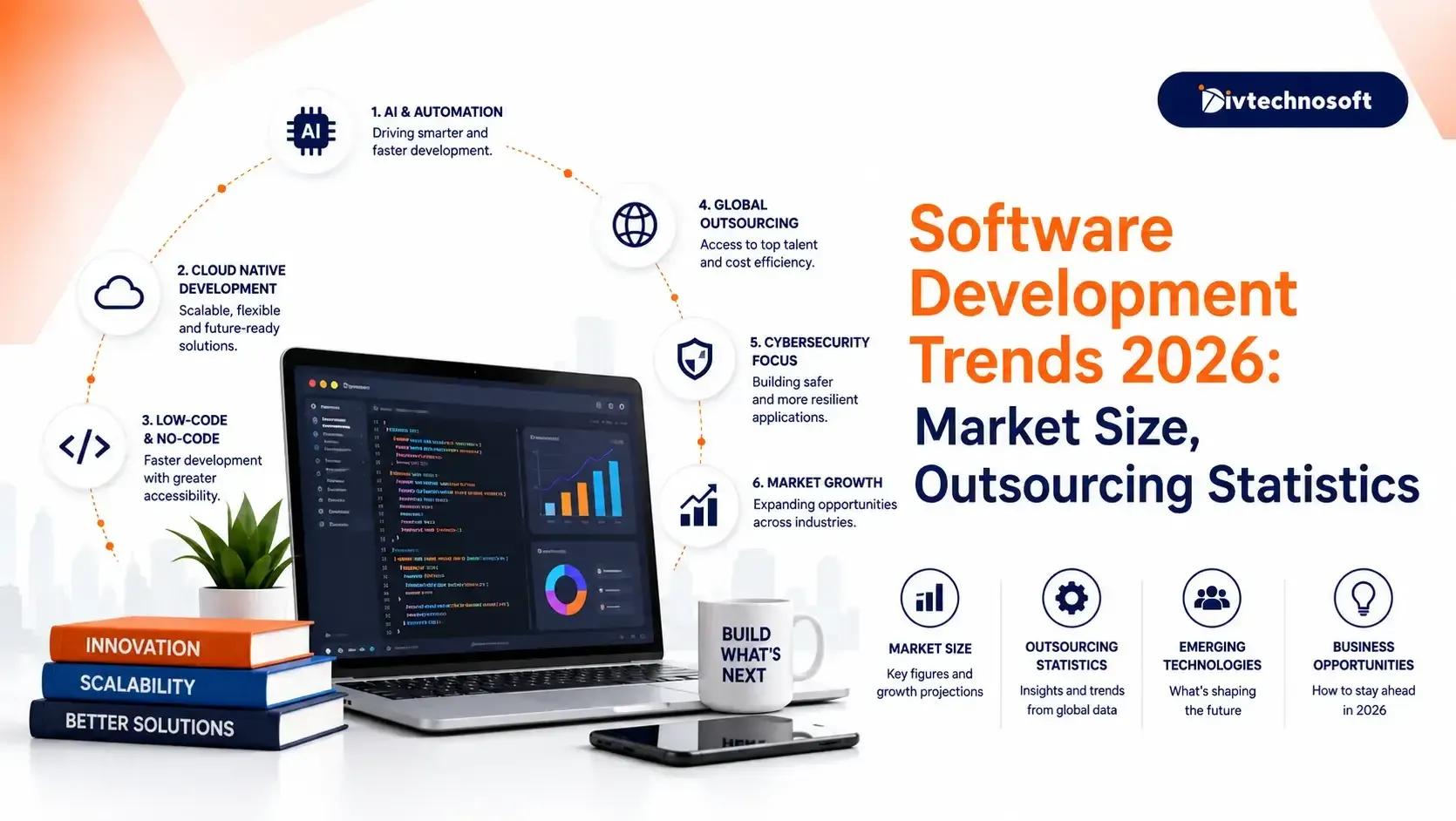
The software landscape has shifted dramatically from speculative experiments to measurable return on investment. Businesses today prioritize speed-to-market, lean infrastructure, and custom proprietary tools over bloated subscriptions.
To help founders, non-technical executives, and product leaders make data-backed decisions, we have compiled the most critical software development trends, market sizing data, and technology benchmarks shaping the global tech ecosystem in 2026.
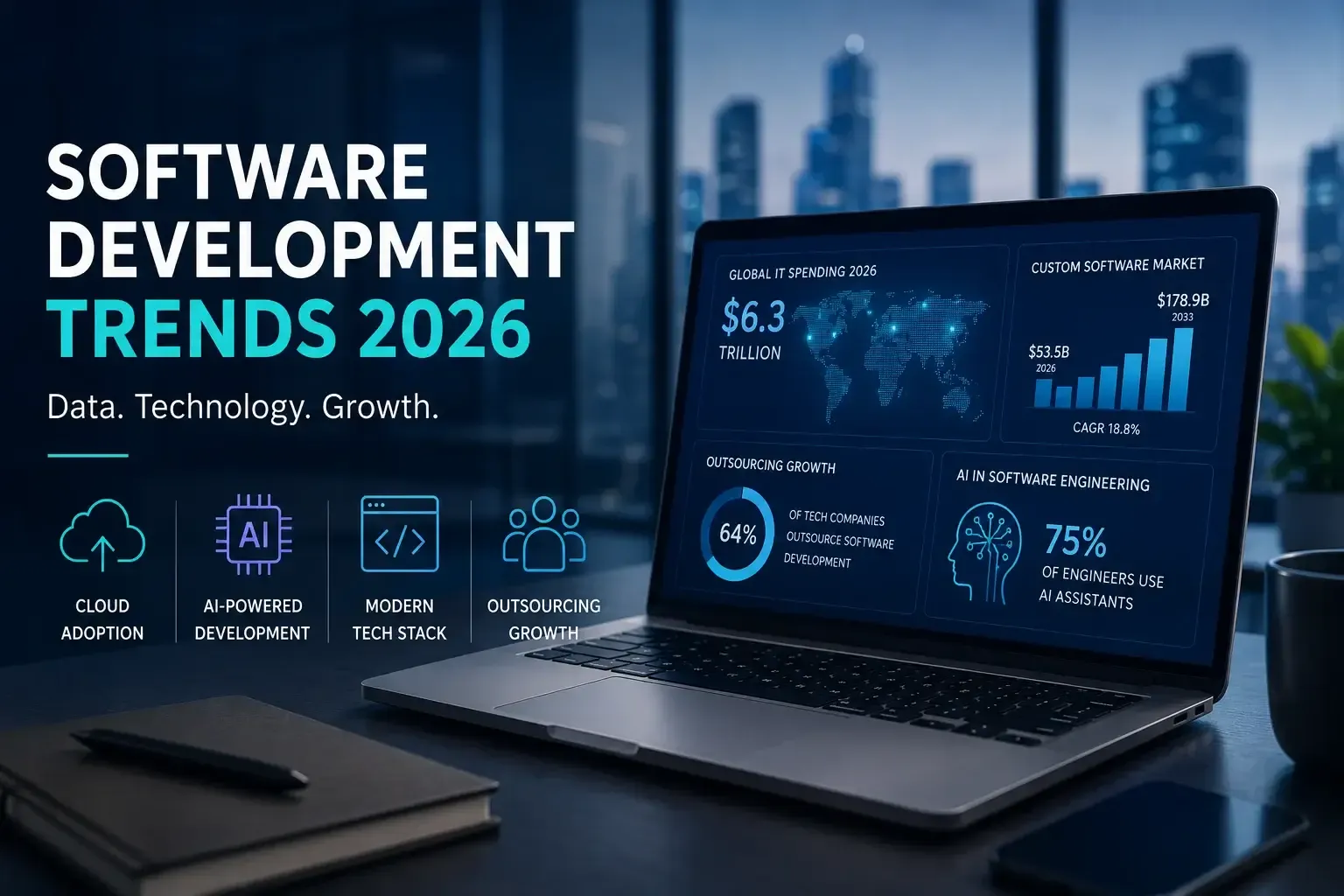
Top Software Industry Trends at a Glance
Global IT & Software Spending: Worldwide IT spending is projected to exceed $6.3 trillion in 2026, heavily accelerated by cloud modernization and autonomous engineering workflows
Custom Software Boom: The custom software development market is valued at $53.5 billion in 2026 and is projected to expand to $178.9 billion by 2033, growing at a compound annual growth rate (CAGR) of 18.8%.
Outsourcing Surge: Over 64% of technology companies now outsource at least a portion of their software development to cut operating overhead and secure specialized engineering talent.
AI-Assisted Engineering: More than 75% of enterprise software engineers actively use AI coding assistants and automation pipelines, reducing boilerplate development time by roughly 30% to 40%.
SaaS Consolidation: 58% of organizations report auditing or actively canceling third-party SaaS subscriptions in favor of tailored, internal web and mobile solutions to curb recurring license creep.
Custom Software Development Market Size & Growth
Why are businesses moving away from pre-packaged, off-the-shelf software? Ready-made platforms often carry escalating monthly seat fees and inflexible feature sets that trap growing companies.
Metric | 2024 | 2026 (Current) | 2030 (Projected) |
|---|---|---|---|
Custom Software Market Value | $38.2 Billion | $53.5 Billion | $118.4 Billion |
Global Enterprise Software Spend | $730.7 Billion | $913.8 Billion | $1.39 Trillion |
Average Custom App ROI Period | 14 Months | 10.5 Months | 8 Months |
SMBs Investing in Custom Tools | 31% | 46% | 63% |
The data confirms that the custom software development market is accelerating rapidly. Rather than renting standard SaaS templates, mid-market enterprises and funded startups are choosing tailored architectures. Explore how modern companies build scalable, dedicated platforms through ourCustom Software Development Services.
Software Development Outsourcing Trends: In-House vs. Agency
Hiring in-house developers involves long recruitment cycles, high local salaries, and substantial retention overhead. These market pressures have fueled recent software development outsourcing trends:
Cost Efficiency: Outsourcing software builds to dedicated development agencies lowers project overhead by 40% to 70% compared to maintaining an equivalent in-house engineering team in North America or Western Europe
Speed to Market: Dedicated external engineering teams launch functional software products 45% faster than internal teams who are frequently interrupted by routine legacy maintenance.
Talent Shortage Relief: 71% of technology leaders cite instant access to niche talent (such as cloud architects, mobile engineers, and automation specialists) as their primary motivation for choosing external development partners.
The Hybrid Model: 52% of tech firms now operate on a hybrid setup—keeping high-level product strategy internal while outsourcing actual sprint execution, testing, and UI/UX design to dedicated partner agencies.
Key Takeaway: Outsourcing is no longer viewed merely as a cheap labor alternative. In 2026, it operates as a strategic speed advantage for companies aiming to validate and ship products before competitors.
Prevailing Software Trends: How Modern Applications Are Built
Evaluating broader software industry trends reveals clear patterns in how non-technical founders and CTOs approach software architecture:
Micro-SaaS & Lean MVPs Take Precedence: Startups have abandoned the monolithic 18-month product release cycle. Over 68% of new digital products now launch as lean, single-feature prototypes in under 90 days to capture early validation and investor interest. To address this demand, specialized tech partners have introduced standardized launch frameworks such as Divtechnosoft's accelerated MVP framework designed to ship production-ready software in under 6 weeks. You can also explore our core approach via ourRapid MVP Development Services.
The Decline of "SaaS Sprawl": The typical mid-sized business pays for an average of 45 to 65 distinct SaaS subscriptions with roughly 30% of paid user seats sitting unused. This financial waste has spurred high interest in consolidating disconnected software tools into unified, custom-built internal applications.
Cross-Platform Mobile Uniformity: Rather than funding separate native iOS and Android development teams, over 60% of new mobile applications rely on modern cross-platform frameworks (like Flutter and React Native), slicing initial code maintenance costs in half.
Software Development Technologies Leading the Industry
The choice of tech stack directly influences maintenance costs, security, and scalability. Here is where the industry is directing capital and developer resources:
Most Adopted Software Development Technologies in 2026
Backend & Cloud: Node.js, Python, Go, Serverless Architecture
Frontend & Web: React, Next.js, TypeScript, Tailwind CSS
Mobile Ecosystem: Flutter, React Native, Swift, Kotlin
Automation & Data: Python, n8n, LangChain, PostgreSQL, Vector Databases
Python & Node.js Dominance: Python remains the default choice for data pipelines, AI modeling, and automation, while Node.js and TypeScript power high-performance, asynchronous web backends
Serverless Infrastructure: Over 48% of web applications run on serverless cloud setups (AWS Lambda, Google Cloud Run), cutting server idle costs and automatically scaling with traffic spikes.
Autonomous AI Agents: The fastest-growing segment in technology adoption involves autonomous workflow execution. Businesses are actively deploying intelligent bots to automate repetitive operations—see how teams implement these using ourCustom AI Solutions & Automation Services.
Recent News in the Software Development Industry & Industry Dispatches
Keeping track of recent news in the software development industry highlights the major practical disruptions that digital agencies and engineering labs are actively solving in production:
Real-Time Data Orchestration in High-Throughput Apps: Modern web applications are prioritizing sub-second latency for live scheduling and high-volume operations. This focus is highlighted in recent engineering coverage, including Divtechnosoft's case study on real-time platform architectures that maintain data integrity during concurrent traffic surges.
Security & Supply Chain Mandates: Following high-profile software vulnerabilities, zero-trust cloud architecture and automated vulnerability auditing are now mandatory requirements for enterprise-level custom software contracts.
Autonomous AI Agents in Production: AI has shifted from simple conversational text prompts to autonomous action agents capable of orchestrating complex database tasks, processing orders, and synchronizing multi-step API workflows without human intervention.
Stricter Data Privacy Regulations: Global privacy updates have pushed businesses to favor self-hosted, dedicated cloud databases over third-party shared platforms to retain full ownership over their user records.
Summary: What This Means for Your Business
Navigating current software trends comes down to one principle: efficiency through custom ownership. Whether replacing costly commercial subscriptions, accelerating time-to-market with a streamlined MVP, or engaging a dedicated outsourcing partner, successful businesses are investing in proprietary software that scales on their own terms.
Frequently Asked Questions
How much is the software development industry worth?
The custom software development market alone is valued at $53.5 billion in 2026, on track to reach $178.9 billion by 2033 at an 18.8% CAGR. Zooming out further, global IT and software spending overall is projected to exceed $6.3 trillion in 2026, driven largely by cloud modernization and AI-assisted engineering workflows.
What is the biggest software development trend in 2026?
The clearest shift is away from bloated SaaS toward lean, custom-built software. Mid-sized businesses average 45-65 SaaS tools with nearly 30% of seats unused, pushing 58% of organizations to cancel subscriptions for tailored internal solutions. Alongside this, 68% of new digital products now launch as fast, single-feature MVPs in under 90 days instead of long 18-month cycles.
What are the trending software developments?
Key developments include lean MVPs launching in weeks instead of months, serverless cloud infrastructure, and real-time systems that handle live, high-volume activity without lag.ValeKit, a valet parking platform, is a good example of the real-time trend vehicle status, tickets, and staff assignments stay synced instantly across locations, even during peak check-in rushes.