Next.js vs React.js in 2026: Which Should You Choose?
Comparing Next.js vs React.js in 2026. Explore key rendering differences, SEO impact, performance, and costs to pick the best fit for your product.

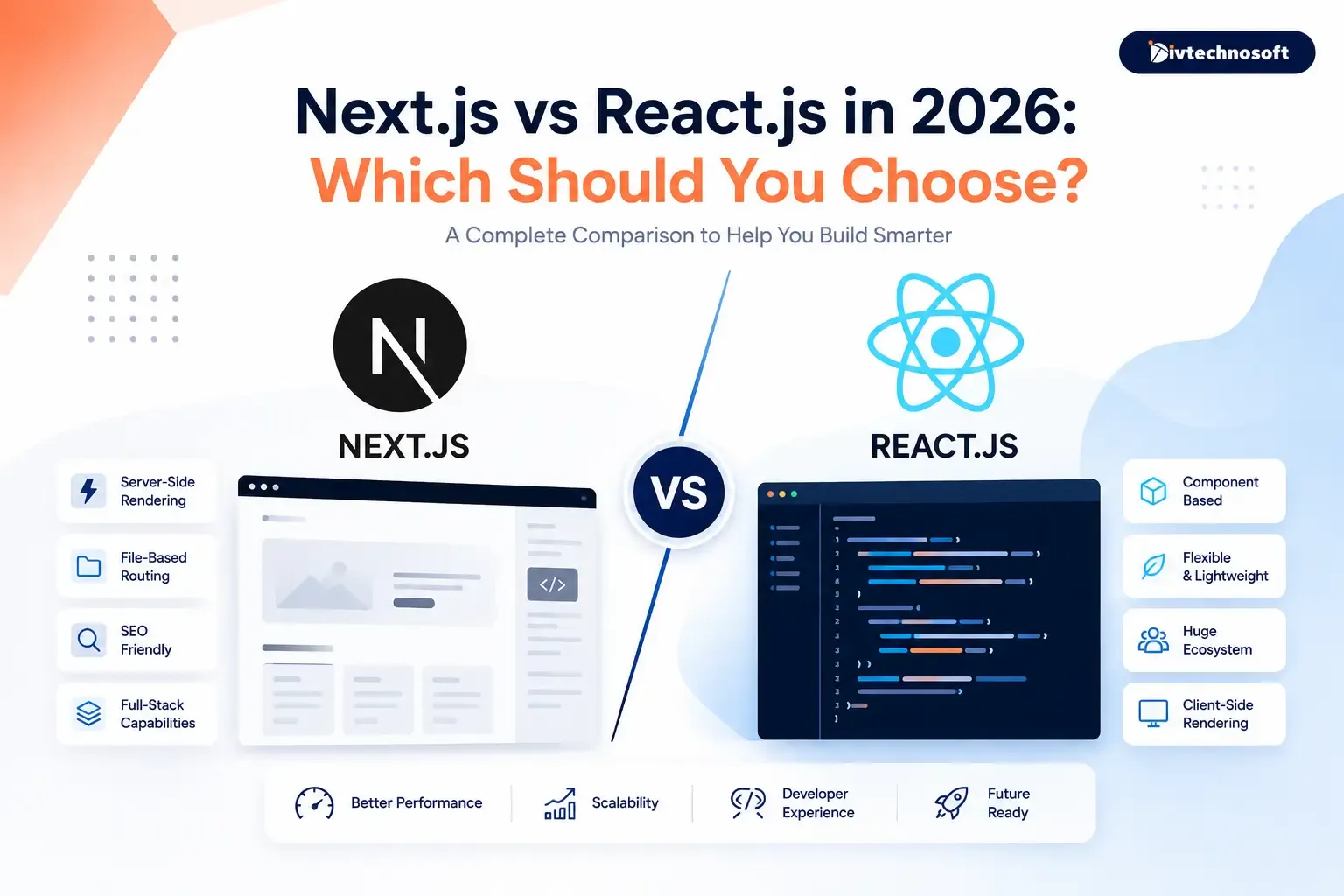
Modern web applications in 2026 require ultra-fast load speeds, smooth user experiences, and immediate search engine visibility. Choosing between Next.js vs React.js is a critical decision when planning your web product architecture.
While React serves as a flexible user interface library, Next.js provides a full-stack framework built on top of React. Understanding the difference between Next.js and React helps you choose the right tool for your project and avoid costly rewrites.
When evaluating React vs Next.js for web development, the decision comes down to rendering power, routing structure, and search engine optimization. In this comparison of Next.js vs React 2026, we cover structural differences, rendering performance like Server-Side Rendering and Client-Side Rendering, and ideal product use cases.
Key Differences: Next.js vs React.js
To choose the right tool for your project, you must first understand the fundamental difference between Next.js and React. While they work closely together, they serve two distinct architectural roles in web development.
React.js: A Front-End User Interface Library
React is an open-source JavaScript library focused exclusively on building component-based user interfaces. It handles the view layer of your web application, allowing developers to create reusable UI elements like buttons, forms, and navigation bars.
By default, standard React relies on Client-Side Rendering (CSR). When a user visits a React website, their browser downloads a minimal HTML page along with a JavaScript bundle. The browser then executes that JavaScript to construct and render the page content.
Next.js: A Full-Stack React Framework
Next.js is a production-ready framework built directly on top of React. While React provides the UI components, Next.js supplies the surrounding infrastructure, including routing, server-side data fetching, asset optimization, and security headers.
Out of the box, Next.js offers hybrid rendering strategies that run on the server before reaching the user browser:
Server-Side Rendering (SSR): Generates HTML on the server for every incoming user request, ensuring fast initial loads and instant search engine indexability.
Static Site Generation (SSG): Pre-renders HTML pages at build time, serving ultra-fast static files through global distribution networks.
Incremental Static Regeneration (ISR): Updates individual static pages in the background without needing to rebuild the entire website.
React Server Components (RSC): Renders complex UI components on the server to keep user JavaScript bundle sizes small and secure sensitive logic.
Next.js vs React.js: Which is Better in 2026?
Evaluating Next.js vs React 2026 requires comparing how each tool handles rendering, search engine optimization, routing, and backend operations. While React provides core client-side primitives, Next.js delivers an integrated full-stack architecture out of the box.
Feature | React.js (Client-Side) | Next.js (Full-Stack) |
|---|---|---|
Rendering | Client-Side Rendering (CSR) | Server Components (RSC), SSR, SSG, ISR |
Initial Load | Slower (downloads full JS bundle) | Instant (pre-rendered HTML) SEO |
SEO | Manual third-party setup | Built-in metadata & Open Graph APls |
Routing | Requires react-router | File-system App Router |
Backend | Requires separate server | Built-in APl routes & Server Actions |
Core Differences
Rendering & speed: React builds the page in the browser after the JavaScript downloads. Next.js uses React Server Components to render pages on the server first, which generally means faster load times and better Core Web Vitals.
SEO: Standard React can be tricky for search engines to index properly. Next.js sends ready-made HTML and handles meta tags on the server, so crawlers have less trouble with it.
Routing: React needs a separate routing package to move between pages. Next.js handles this automatically based on your folder structure, through its App Router.
Backend integration: React usually needs its own backend, like an Express server, running alongside it. Next.js can handle server-side logic directly, through API routes and Server Actions.
To see how real-time server rendering and cross-platform synchronization work in practice, explore ourPersonal Finance Tracker App Case Study. Divtechnosoft built a secure web and mobile solution using modern JavaScript architecture for fast data delivery and smooth performance.
Choosing the Right Framework for Your Product
Selecting between React vs Next.js for web development depends on your product goals, target audience, and business requirements. Matching your project type to the right tool ensures fast delivery, optimal performance, and lower long-term maintenance costs.
When to Choose Next.js
Next.js makes the most sense when public visibility, page speed, and search discoverability have a direct line to revenue.
E-commerce platforms: Online stores need fast-loading, easily indexed product pages so they rank well and convert visitors into buyers.
SaaS marketing portals: Public landing pages and marketing sites lean on server pre-rendering to hit strong Core Web Vitals and pull in organic traffic.
Content-heavy web apps and blogs: News sites, media hubs, and documentation portals rely on Static Site Generation and Incremental Static Regeneration to serve large audiences instantly.
SEO-driven products: Anywhere organic acquisition is core to the strategy, Next.js's server-side rendering and built-in meta management do the heavy lifting.
When to Choose React.js
Standard React remains an excellent choice for private software products where search engine crawlers do not need access to the content.
Gated Web Dashboards: Logged-in web portals and customer portals focus purely on rich user interaction behind a login screen where SEO is irrelevant.
Internal Admin Tools: Back-office management systems, internal enterprise tools, and analytics dashboards benefit from React's simple client-side architecture and flexible state management.
Single-Page Applications (SPAs): Products focused strictly on dynamic user interactions without page transitions or indexing needs run efficiently on standard React.
Cross-Platform Web and Mobile Codebases: Teams using React Native for mobile apps can share UI components, business logic, and state management hooks seamlessly with a React web client.
Fast-Tracking Your Product Launch
Choosing between Next.js and React is only the first step. For startups and product teams, the real challenge is bringing that architecture to market quickly without burning through early capital.
Creating a comprehensive digital platform internally is often resource-heavy and time-consuming. Instead, partnering with expert MVP Development Services empowers founders to transform their concepts into production-ready Next.js or React applications within a 4-to-7-week window.

By focusing strictly on essential user workflows, modular MVP engineering provides several strategic advantages:
Fast Market Entry: Ship a high-performance web product rapidly to gather feedback from real users instead of relying on assumptions.
Capital Efficiency: Concentrate engineering budgets on core problem-solving features while keeping architecture clean and maintainable for future sprints.
Scalable Tech Foundation: Deploying on Next.js or React from day one ensures your code can scale smoothly as traffic grows, preventing expensive platform rewrites later.
Investor-Ready Milestones: Create functional web applications and click-to-demo flows that prove user traction to venture capitalists and stakeholders.
FAQs
Can you convert a React app to Next.js later?
Yes. You can migrate incrementally by keeping your existing React components and gradually updating your routing, data fetching, and page layouts.
Is Next.js harder to learn than React?
Next.js has a small extra learning curve due to server-side concepts, but developers who already know React can pick it up quickly.
Which framework is cheaper to host and maintain?
Standard React apps are cheaper to host as static files, while Next.js slightly increases server costs for SSR but reduces long-term plugin maintenance.
Choose Your Tech Stack
Choosing between Next.js and React.js depends on your product goals, target audience, and speed needs. Use Next.js if you need high search engine rankings, fast page loads, and built-in server features to drive product revenue. Choose React.js for gated dashboards, internal tools, and single-page applications that do not need public search indexing.
Ready to build a high-performance web product? Partner withDivtechnosoft to select the right front-end architecture, plan your technical roadmap, and fast-track your market launch. Schedule a strategy session with our team today.