Voice AI for Customer Support: Benefits, Uses & More
Learn how voice AI for customer support automates calls, cuts costs, and boosts satisfaction. Explore key use cases and implementation steps.

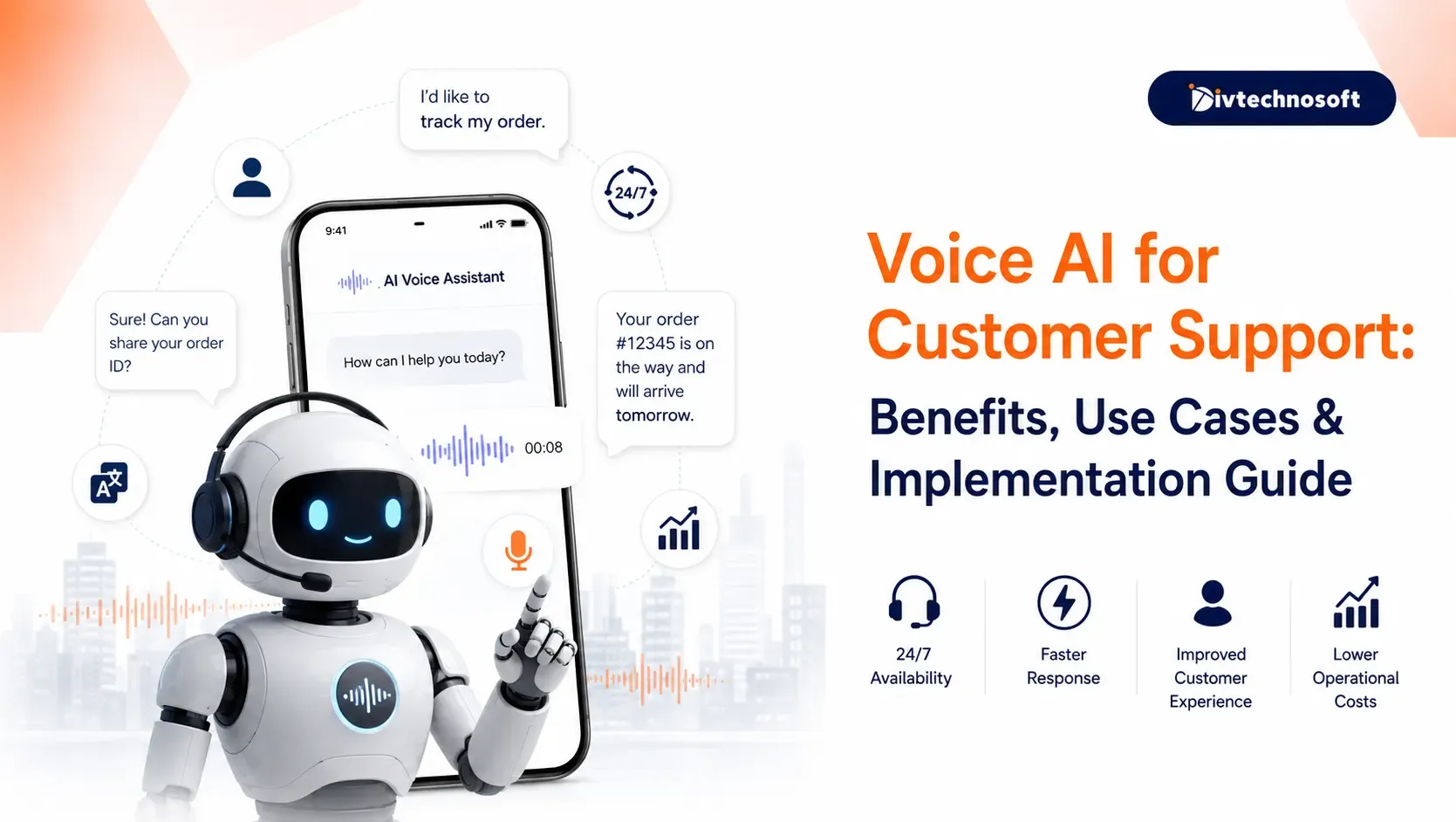
Traditional call centers are struggling to keep up with customer demand. Long hold times irritate callers, while support agents face high stress and burnout from answering the same basic questions all day. This constant pressure leads to high staff turnover and rising operational costs.
Conversational voice AI changes how businesses handle phone support. Unlike rigid phone menus that force callers to press buttons, voice AI listens, understands, and responds like a real human. It handles routine calls naturally, giving customers fast answers without placing them on hold.
In this guide, you will learn how voice AI for customer support works, its main business benefits, practical use cases, and how to build a voice bot step by step.
What is Voice AI for Customer Support?
Voice AI for customer support refers to technology that allows computers to understand and speak with human callers. A voice bot for customer support listens to what a customer says over the phone, processes the request, and provides a clear response instantly.
Instead of following rigid scripts, this technology holds natural, two-way conversations to solve customer problems quickly.
Key Components of Voice AI
To understand how a voice bot works, it helps to look at its three main building blocks:
Speech-to-Text (STT): Converts the caller's spoken words into written text in real time.
Natural Language Processing (NLP): Analyzes the text to understand the caller's intent, context, and emotion.
Text-to-Speech (TTS): Converts the AI's written response back into a natural, human-sounding voice.
Voice AI vs. Traditional IVR
Most people have run into traditional IVR systems at some point. They force callers through rigid, multi-step menus, "press 1 for sales," "press 2 for billing," and if the problem doesn't fit neatly into one of those options, the caller ends up stuck or waiting on hold.
Conversational voice AI does away with that rigid menu structure. Callers just state their problem in plain language, something like "I need to reschedule my delivery for tomorrow," and the AI picks up on the intent right away and takes action.
Real-world implementations like thisAI Voice Agent Platform Case Study show businesses cutting call wait times by up to 80% while scaling call handling across multiple channels.
Top Benefits of AI Voice Agents
Using AI voice agents for customer service gives businesses a modern way to improve support while keeping operational costs low. Here are the key advantages:
24/7 Availability: Provides continuous support at any time of day, including nights, weekends, and holidays, without needing shift rotations.
Lower Operating Costs: According to McKinsey benchmark studies, AI voice resolutions cost around $1.18 per call compared to $7.40 for human agents, driving average operational cost savings of 30% to 53%.
Faster Resolution: Eliminates long hold times by answering calls instantly, helping customer service operations resolve support requests up to 52% faster.
Scale Without Effort: Manages sudden spikes in call volume during sales or outages by handling thousands of calls at the exact same time.
Common Use Cases for Customer Service
A voice bot for customer support can handle many routine tasks that take up a lot of time for human support teams. It can manage appointment scheduling, letting customers book, change, or cancel appointments over the phone while checking calendar availability in real time and sending automated SMS confirmations. It handles order tracking too, so callers can check purchase status and delivery dates just by providing an order number. For basic troubleshooting, the AI answers common FAQs and walks users through simple step-by-step fixes for everyday product issues. And when a call needs a human touch, voice agents handle call routing by screening incoming calls, identifying the caller's main issue, and transferring complex problems to the right agent.
How to Build & Test Your First Voice AI Solution
Building a successful voice AI system requires a clear plan. Here is a step-by-step guide to launch your AI voice bot effectively:
Start Small with an MVP
Before building a massive system, start with a Minimum Viable Product (MVP). An MVP allows you to test core voice capabilities on a few high-volume query types, collect real caller feedback, and refine user flows quickly before investing in full-scale deployment.
For professional support in turning your idea into a functional prototype, exploreDivtechnosoft MVP Development Services. Their team builds scalable AI prototypes fast, giving you an investor-ready solution designed for long-term growth.
Choose the Right Tech Stack
Your technology stack forms the engine of your voice bot. Combine modern AI language models such as OpenAI or Gemini for understanding intent with dependable telephony solutions like Twilio for routing calls.
Train Your AI Model
Feed your AI model existing support scripts, knowledge base articles, and common FAQs. This ensures your AI voice agents for customer service deliver accurate, brand-aligned answers and follow your business rules.
Monitor Performance
Track core metrics to measure success after launch. Focus on key metrics like first-call resolution rates, average handling time, transfer rates to human agents, and caller feedback scores to continuously improve performance.
Key Challenges and How to Fix Them
Rolling out voice AI comes with a few technical hurdles worth understanding upfront, so you can build a more reliable system from the start.
Handling Complex Queries
Voice bots handle routine tasks well, but they tend to struggle when a customer issue gets complicated or emotionally charged. A recent Gartner Customer Survey found that 87% of customers consider immediate access to a human agent essential when engaging with AI-driven customer service.
Accents and Background Noise
Calls come in from all kinds of environments: cars, busy streets, loud rooms, and speakers bring a wide range of regional accents with them. Modern speech recognition models help by filtering out background noise, and training your AI on diverse audio samples improves its ability to pick up different accents and speaking speeds accurately.
Data Security
Protecting sensitive customer details, like payment information or personal identity, over the phone is essential for earning trust. Voice data should be encrypted both during calls and when stored, and your setup should comply with standard data privacy regulations to keep customer information safe.
FAQs
How long does it take to deploy a custom Voice AI bot?
A basic MVP testing core query flow can be deployed in 2 to 4 weeks. Full enterprise builds with custom backend integrations and multi-language support typically take 5 to 7 weeks.
What happens when the Voice AI cannot answer a question?
The AI uses sentiment analysis and confidence scoring to detect complex or emotionally charged issues, triggering an instant live agent transfer along with the full call transcript so the customer never repeats themselves.
Is Voice AI compliant with data privacy regulations?
Yes. Enterprise voice AI platforms enforce end-to-end call encryption, PCI-DSS compliance for payment details, and strict data privacy standards (such as HIPAA for healthcare or GDPR for personal data).
Get Started with Voice AI
Adopting voice AI for customer support is no longer just an option for modern businesses. It is essential for scaling your support team. By automating routine calls, reducing wait times, and lowering operational costs, voice AI allows you to deliver reliable, around-the-clock service without overwhelming your human agents.
Divtechnosoft helps you design, build, and deploy custom AI voice solutions tailored to your business workflows. From rapid MVP prototypes to scalable call platforms, their team delivers reliable systems built for long-term growth.