How Retrieval-Augmented Generation Powers Enterprise AI
Discover how Retrieval-Augmented Generation (RAG) stops LLM hallucinations and connects AI models to real-time company data.

Generative AI is transforming modern business, but static training data and made-up facts hold back full enterprise adoption. When AI tools generate incorrect answers or lack access to confidential company files, business leaders hesitate to deploy them to customers and staff.
Retrieval-Augmented Generation (RAG) bridges this gap by connecting Large Language Models (LLMs) to private, real-time knowledge bases. Instead of relying solely on broad background data, RAG allows AI systems to pull precise facts directly from your internal company documents before generating a response.
Understanding RAG architecture helps teams build accurate, secure AI products. In this guide, we explain how RAG works step by step, its core advantages over model fine-tuning, real-world enterprise applications, and how to fast-track your own RAG-powered software project.
What is RAG? Solving the Limits of Static LLMs
To understand why Retrieval-Augmented Generation is so important, you first need to understand how standard Large Language Models work and where they fall short.
Standard LLMs are trained on massive public datasets. Once training finishes, their knowledge is locked in place. This creates three major challenges for enterprise businesses:
Knowledge Cutoffs: Standard models know nothing about recent events, updated news, or real-time market changes that happened after their training finished.
AI Hallucinations: When an LLM does not know the answer to a question, it often generates plausible-sounding facts instead of admitting it lacks information.
Lack of Private Context: Base AI models do not have access to your company documents, customer records, standard operating procedures, or internal databases.
Defining Retrieval-Augmented Generation
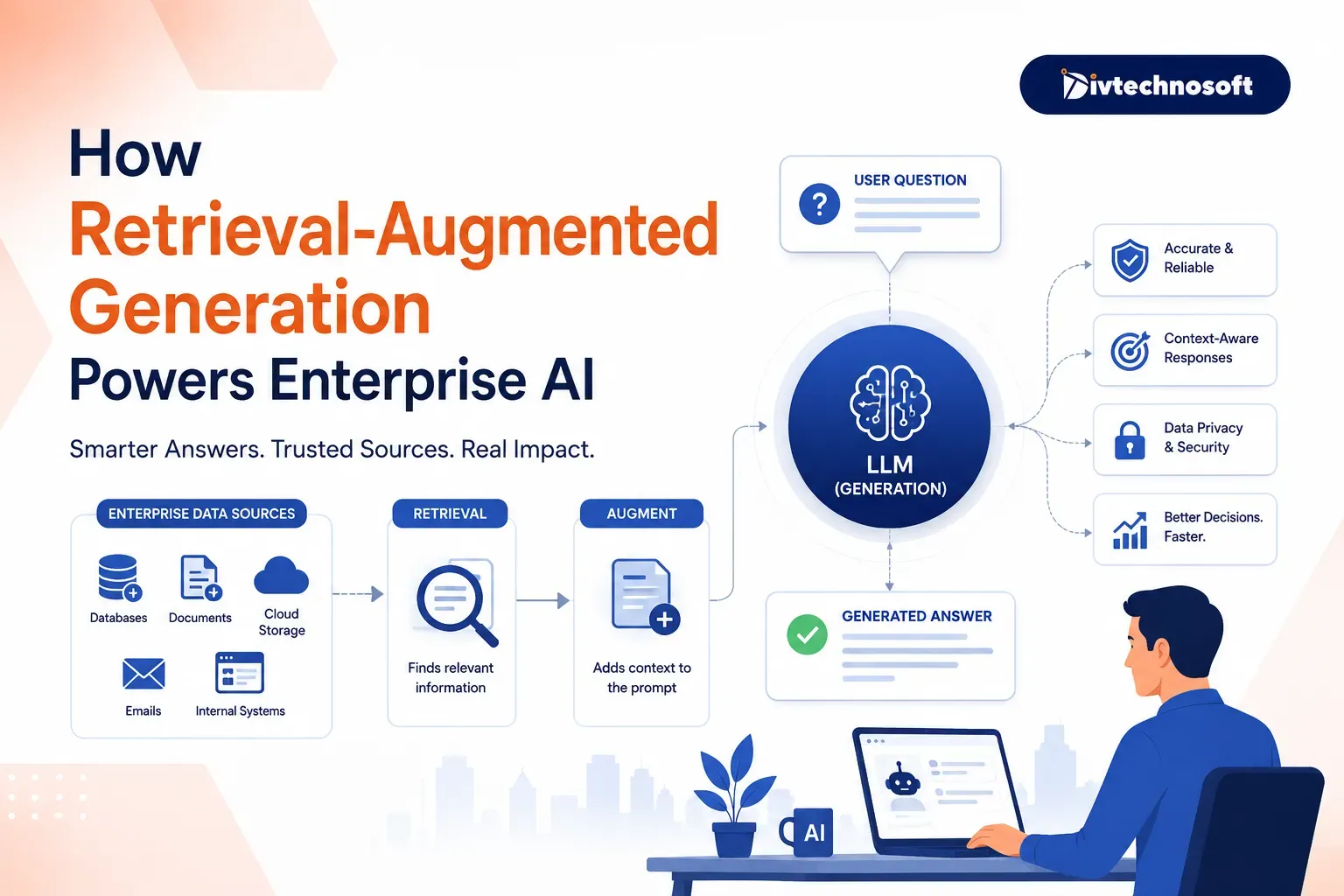
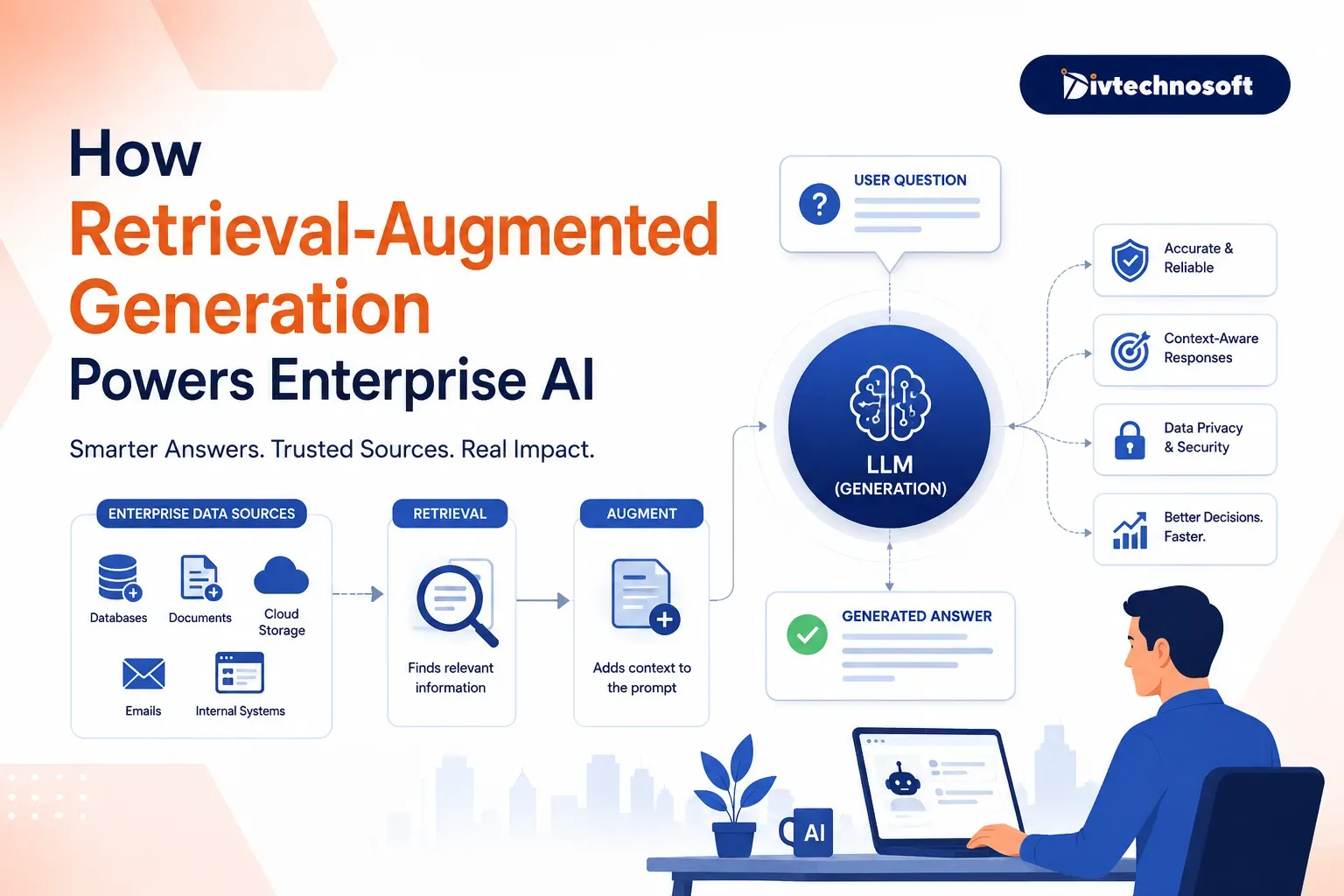
Retrieval-Augmented Generation (RAG) solves these limitations by combining two functions: document retrieval and text generation. Instead of relying purely on the LLM's memory, a RAG system first searches your external knowledge sources for relevant documents, then feeds them to the LLM alongside the user's prompt. The model reads that context and generates an accurate, source-backed answer.
How Retrieval-Augmented Generation Works
A RAG pipeline turns raw company documents into accurate AI responses through a simple three-step workflow.
1. Ingestion and Vector Storage
First, your company files, such as PDF manuals, text documents, or database tables, are broken down into small chunks. An embedding model converts these text chunks into numerical vectors, which represent the mathematical meaning of the words. These vectors are then stored in a specialized vector database for instant searching.
2. Semantic Retrieval
When a user asks a question, the system converts that question into a vector using the same embedding model. It searches the vector database to find the text chunks that match the meaning of the question, even if the exact words are different. This step locates the most relevant facts from your knowledge base in milliseconds.
3. Grounded Generation
Finally, the system combines the user's original question with the retrieved text chunks into a single structured prompt. The Large Language Model reads this combined context and generates a clear response based strictly on the provided facts. This ensures every answer remains grounded in your official data.
Why RAG Beats Fine-Tuning for Enterprise AI
When building custom AI applications, teams often decide between fine-tuning a model or implementing a RAG framework. Fine-tuning rewrites a model's internal weights, while RAG connects the model to external reference files. For most business applications, RAG provides a faster, cheaper, and more reliable path.
Stops AI Hallucinations
Because a RAG system forces the AI to answer using retrieved documents, it dramatically reduces fake information. The model can cite specific paragraphs and source links, allowing users to verify every response against actual company records.
Provides Real-Time Data Without Costly Retraining
Retraining or fine-tuning Large Language Models requires heavy computing power, expensive GPUs, and long processing times. With RAG, updating your AI knowledge base is as simple as adding or removing documents from your vector store. Your AI gets access to fresh data instantly without retraining costs.
Protects Sensitive Company Data
RAG allows enterprise teams to enforce strict permission levels over company information. You can set up security rules so users only retrieve documents they are authorized to see. This keeps confidential HR records, financial metrics, and executive reports completely secure while using a shared AI model.
Bringing RAG-Powered Products to Market with Agility
Building a secure RAG pipeline requires integrating vector stores, document processing, and prompt workflows. Instead of spending months building heavy infrastructure from scratch, modern product teams build focused prototypes to test performance and validate business demand early.
Partnering with experiencedMVP Development Services enables organizations to turn private knowledge bases into functional AI tools within weeks.
This phased approach gives software teams clear commercial and technical benefits:
Fast Market Feedback: Deploy interactive AI search tools quickly to gather usage patterns and refine response quality based on real user queries.
Controlled Operational Expenses: Test different vector stores and embedding models early to keep monthly cloud infrastructure and API costs low.
Cleaner Architecture: Build clean, scalable data connections that integrate smoothly with your existing web apps and mobile interfaces.
Validated ROI: Present a working, source-cited AI tool to executive sponsors or investors to prove accuracy before committing larger engineering resources.
Real-World Use Cases for RAG in Modern Business
Retrieval-Augmented Generation turns abstract AI concepts into practical business tools. Organizations across industries use RAG to unlock value from their existing documents and data.
Internal Knowledge Search and Employee Assistants
Companies sit on huge volumes of information spread across policy manuals, code repositories, and project folders, and employees often burn hours just tracking down a single answer. RAG-powered internal assistants scan through all of that instantly, giving workers precise answers along with source links so they can get back to work faster.
Customer Support Chatbots with Live Policy Integration
Traditional support bots tend to frustrate users with rigid, scripted replies. RAG changes that by letting support bots read live product catalogs, return policies, and troubleshooting guides, so they can give natural, accurate answers grounded in current company policy, which in turn cuts down ticket volume for human agents.
Automated Financial, Legal, and Compliance Analysis
Financial and legal teams deal with mountains of dense reports, contracts, and regulatory filings. With RAG, analysts can upload lengthy documents and ask direct questions about specific terms, risks, or figures, and the system will pull the exact clauses and summarize the key points accurately.
To see how custom AI models and automated knowledge systems work in practice, take a look at this Ringlyn AI Voice Agent Platform Case Study, which walks through how an intelligent system handles real-time business tasks and customer questions.
FAQs
Which vector database should you choose for RAG?
It depends on your scale and existing stack. Managed cloud options like Pinecone offer fast setup for early prototypes, while open source databases like Qdrant, Milvus, or Weaviate provide fine-grained deployment control. You can also start with pgvector in PostgreSQL if you want to keep your data infrastructure simple.
Is private company data safe when using RAG?
Yes. Your documents stay stored inside your secure vector database or private enterprise cloud. When a user asks a question, the system only sends small, relevant text snippets to the LLM API to generate the final response.
How much does it cost to build and run a RAG application?
Costs depend on your data volume and query traffic. Initial setup expenses focus on data processing, chunking, and application logic. Monthly operational costs remain low because vector database queries and embedding API calls cost a fraction of a cent per request.
Scale Your AI Strategy
Retrieval-Augmented Generation gives companies a reliable way to use generative AI without static data limits or made-up facts. By connecting Large Language Models to your private files, you get instant answers backed by real sources, strong data privacy, and lower operational costs compared to model retraining.
Ready to transform your company data into an intelligent AI system? Partner withDivtechnosoft to build secure, scalable RAG solutions tailored to your business needs. Contact us today to schedule your consultation.