How to Create an App Like Uber?
Learn how to create an app like Uber with key features, development steps, technology stack, and cost considerations for building a ride-sharing platform.

The ride-sharing industry continues to grow rapidly, creating opportunities for businesses to build innovative transportation platforms.
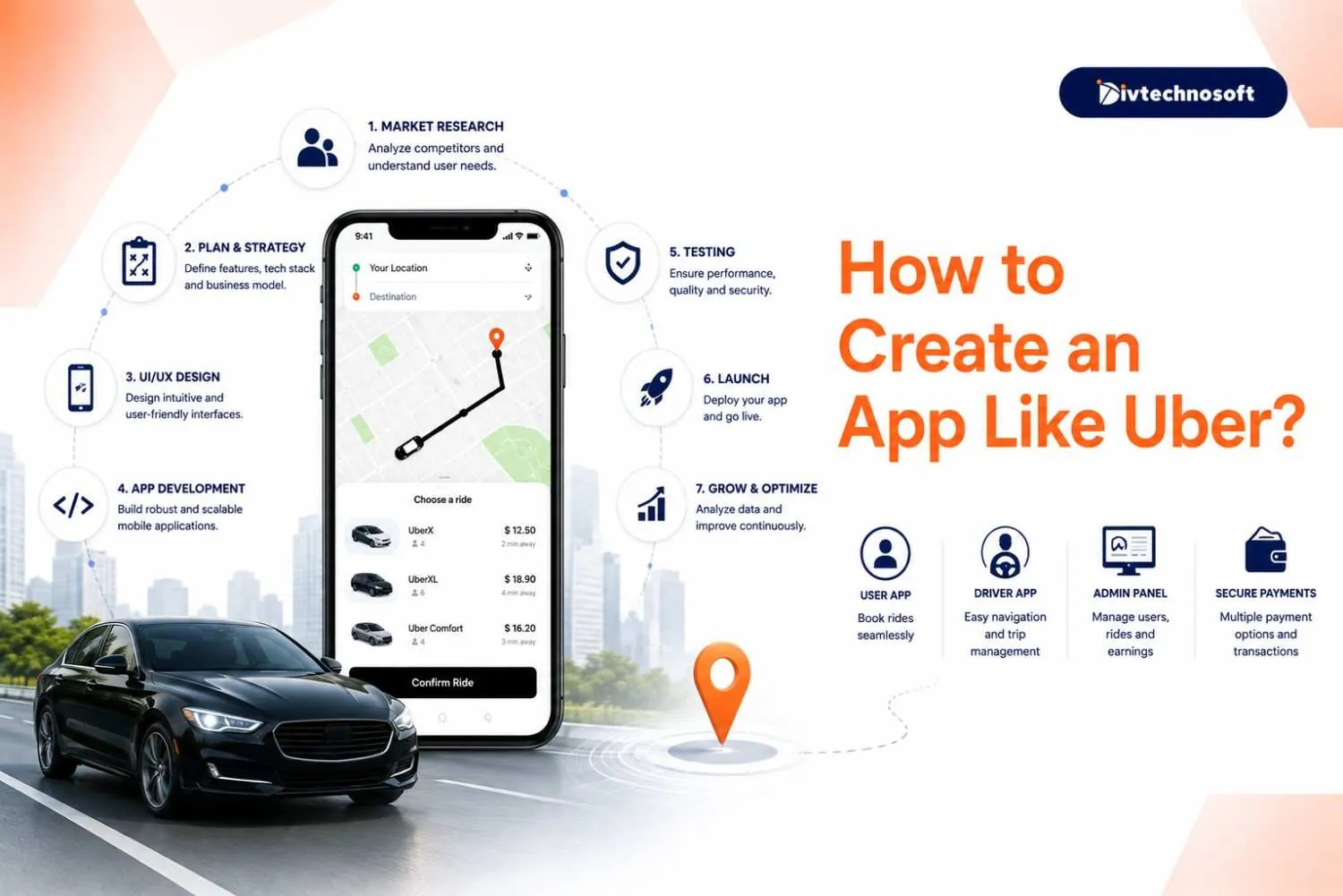
Creating an app like Uber requires more than basic ride booking, it involves real-time tracking, smart scheduling, secure payments, and smooth communication between drivers and passengers.
Instead of copying every feature, the key is to build an MVP focused on solving a specific problem for a targeted audience. A scalable and well-structured system helps ensure better performance, efficient operations, and long-term growth.
Components of a Ride-Sharing App
An app like Uber is not just one application. It is a complex ecosystem consisting of three distinct parts that must work in perfect harmony.
1. The Passenger App
This is the interface the customer sees. It needs to be incredibly fast and intuitive. Key features include:
Registration and Profile: Quick sign-up via social media or phone number.
Real-Time Map: Showing nearby drivers using GPS.
Fare Estimation: Calculating the price before the ride starts.
Payment Integration: Supporting credit cards, digital wallets, and local payment methods.
Rating and Reviews: Ensuring safety and quality control.
2. The Driver App
Drivers need a tool that helps them earn money efficiently. Their version of the app includes:
Status Toggle: Switching between online and offline modes.
Navigation: Built-in maps that show the quickest route to the passenger.
Earnings Dashboard: Tracking daily and weekly income.
Trip History: A log of all completed rides.
3. The Admin Dashboard
This is the control center for the business owner. It allows you to:
Manage Users: Verifying driver documents and handling passenger complaints.
Pricing Control: Setting base fares and surge pricing rules.
Analytics: Seeing which areas of the city have the most demand.
MVP Development: Focus on the Essentials
When you start, it is tempting to want everything.
However, the goal of an MVP is to launch quickly and learn from real users. You should prioritize features that facilitate the core loop: Request, Match, Ride, and Pay.
Why You Should Start Small
Building a full-scale clone costs a fortune and takes years. An MVP allows you to test your market. For example, if you are building a service for a small town, you might realize that people prefer scheduled rides over instant ones. If your platform were too complex, changing that would be difficult.
Key Technologies Required
Frontend
Modern, responsive user interfaces are built using frameworks like ReactJS and Next.js, ensuring fast performance and a smooth user experience.
CRM & ERP Integrations
Enterprise systems are integrated using platforms such as Salesforce, HubSpot, and SAP to streamline customer management, sales workflows, and business operations.
Secure Cloud Deployment
Applications are deployed on reliable cloud platforms like AWS, Google Cloud Platform (GCP), and Microsoft Azure to ensure scalability, security, and high availability.
Use Cases for Custom Logistics Apps
The Uber model is being applied to many industries beyond taxis. Here are some modern use cases:
Corporate Shuttle Services: Managing employee commutes for large campuses.
Medical Transport: Helping patients get to non-emergency appointments.
On-Demand Delivery: Moving everything from groceries to furniture.
Construction Logistics: Coordinating the movement of heavy machinery between sites.
Towing Services: A dedicated app for roadside assistance.
Niche Luxury Transport: Specialized fleets for high-net-worth individuals or events.
Estimated Development Costs and Timeline
Building a high-quality MVP in 2026 requires a professional team. Here is a rough breakdown of what to expect.
Development Phase | Estimated Time | Focus Area |
|---|---|---|
Discovery & Design | 4 to 6 Weeks | User flow and wireframes |
Backend Development | 10 to 14 Weeks | API, Database, and Logic |
Mobile App Development | 12 to 16 Weeks | iOS and Android versions |
QA and Testing | 4 to 6 Weeks | Bug fixing and security audits |
On average, a solid MVP for a ride-sharing app will cost between $40,000 and $90,000, depending on the complexity of the features and the location of your development team.
How Divtechnosoft Can Help You Succeed
Building an app like Uber is a massive technical challenge that requires more than just coding. It requires a partner who understands business logic, scalability, and user behavior.
Divtechnosoft is that partner.
We specialize in building custom, high-performance MVP ecosystems. When you work with usd, you aren't just getting an app; you are getting a scalable business tool.
We help you:
Architect for Scale: Ensuring your app doesn't crash when you go from 10 drivers to 1,000.
Optimize for Speed: Using the latest 2026 tech stacks to ensure sub-second response times.
Integrate Seamlessly: Connecting your app with payment gateways, CRM tools, and marketing automation.
Strategic MVP Planning: Helping you decide which features are essential for launch and which can wait for version 2.0.
We have extensive experience in logistics and on-demand services, making us uniquely qualified to handle the complex back-end requirements of a ride-sharing platform.
FAQs
How much does it cost to create an app like Uber?
The cost depends on features, app complexity, platform, and development team. A basic MVP can cost significantly less than a fully featured ride-sharing platform.
How to create an app like Uber Eats?
To build an app like Uber Eats, you need customer, delivery partner, and restaurant apps along with features like real-time tracking, payments, and order management.
How to create an app like Uber for free?
You can start with no-code or low-code app builders to create a basic version for free, but advanced features and scalability usually require professional development.