MVP Development in 2026: Key Trends, Facts & Insights
40+ MVP development statistics for 2026: cost, timelines, AI-assisted vs no-code vs custom builds, funding correlation, and failure data for founders.

AI coding tools have cut build time. No-code has moved from side project to real launch path. Investors ask for usage data before a pre-seed check even clears. MVP development in 2026 runs on a different playbook than it did three years ago, and most of what's written about it hasn't caught up.
This post sticks to one question: what does it take to go from idea to a validated first version right now? Cost, timelines, build approach, AI tooling adoption, funding, and what happens after launch. Nothing here overlaps with our SaaS market sizing post from last month; that one covers the industry you're selling into, this one covers the product you're building.
MVP statistics 2026: the fast facts
Custom MVP development cost in 2026 runs $15,000-$120,000; most startups land at $40,000-$80,000
40% of new SaaS MVPs are now built primarily with AI-assisted coding
84-90% of developers use or plan to use AI coding tools, up from about 76% two years ago
70-75% of new applications are expected to run on low-code or no-code platforms by year-end 2026, up from under 25% in 2020
25-30% of no-code MVPs get rebuilt in custom code within two years once they hit scaling limits
43% of startup failures trace back to poor product-market fit; still the single biggest cause tracked by CB Insights
Only about 4% of startups that ship an MVP ever reach a seed round
Startups that pivot at least once raise 2.5x more capital and see 3.6x better user growth than ones that never adjust course
MVP development cost in 2026
Cost estimates vary by agency and region, but the bands hold up across most sources.
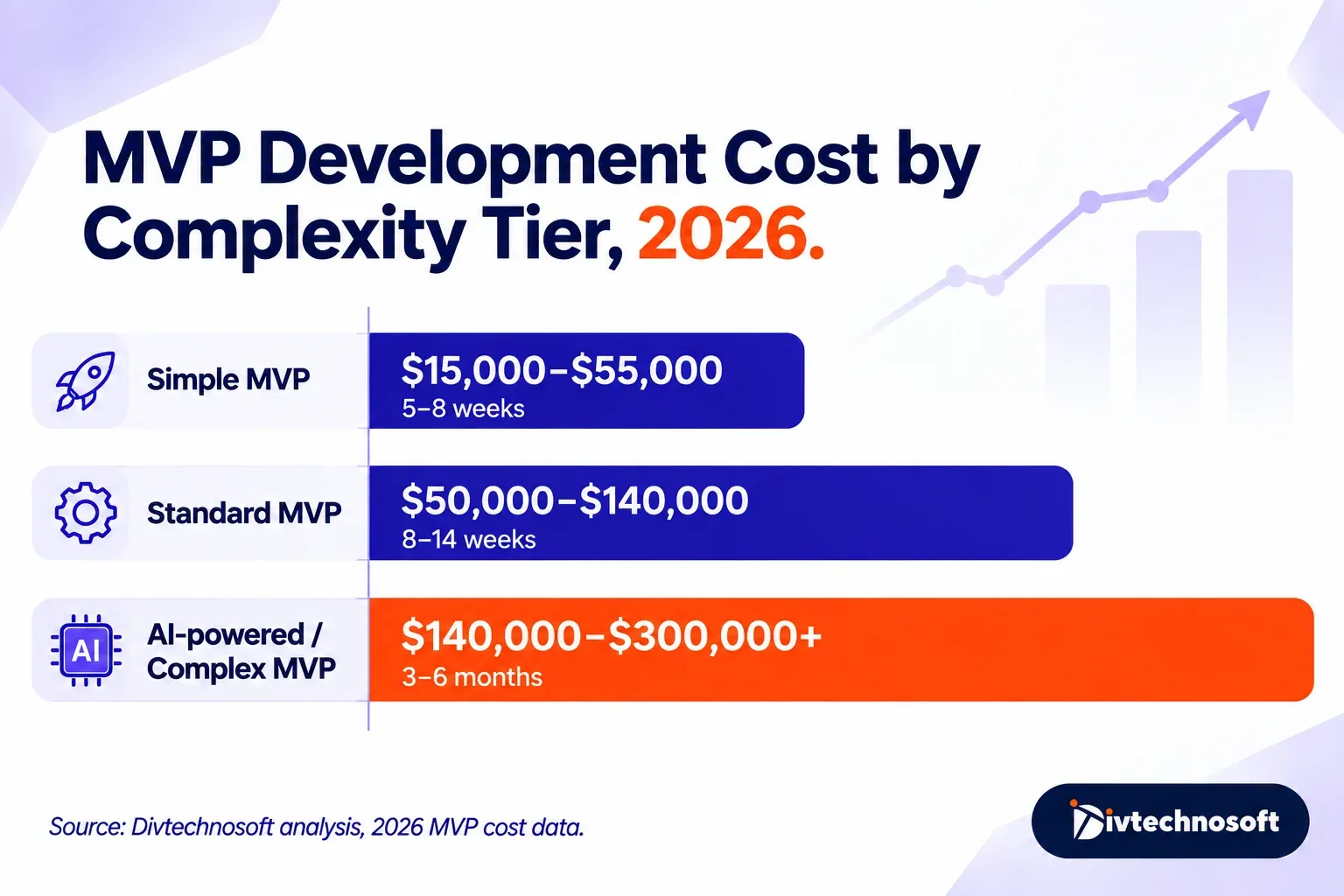
Simple MVP: $15,000-$55,000, 5-8 weeks. One core workflow: a landing page with signup, a basic booking flow, a single-purpose marketplace listing
Standard MVP: $50,000-$140,000, 8-14 weeks. User accounts, payments, a handful of integrations; think a food-delivery app with ordering and checkout
AI-powered or complex MVP: $140,000-$300,000+, 3-6 months. Custom AI features, compliance requirements, multiple user roles
Cost by phase:
Pre-development (research, validation, planning): $3,000-$27,500
Design and prototyping: $6,000-$45,000
Post-launch maintenance: $2,650-$14,500 a month; roughly 20% of the initial build cost annually
Validation payoff: teams that put at least 20% of the MVP budget into pre-development validation are 3x more likely to ship something that succeeds, per Startups.com data
One number cuts against how most founders actually spend. Cutting discovery to save money doesn't save money; it moves the cost to a rebuild.
MVP development timeline in 2026
Simple builds: 6-8 weeks
Standard builds: 3-6 months
High-growth benchmark: 8-12 weeks total; past 16 weeks usually means scope creep, not real complexity
AI copilots cut coding-task time by 30-60%, the main reason 2026 timelines beat 2023-2024 numbers
No-code, AI-assisted, or custom: how MVPs get built
This is the split most MVP cost guides skip, and it's the one that decides both your budget and your risk.
No-code and low-code
70-75% of new applications are projected to run on low-code or no-code platforms by the end of 2026 (Gartner), up from under 25% in 2020
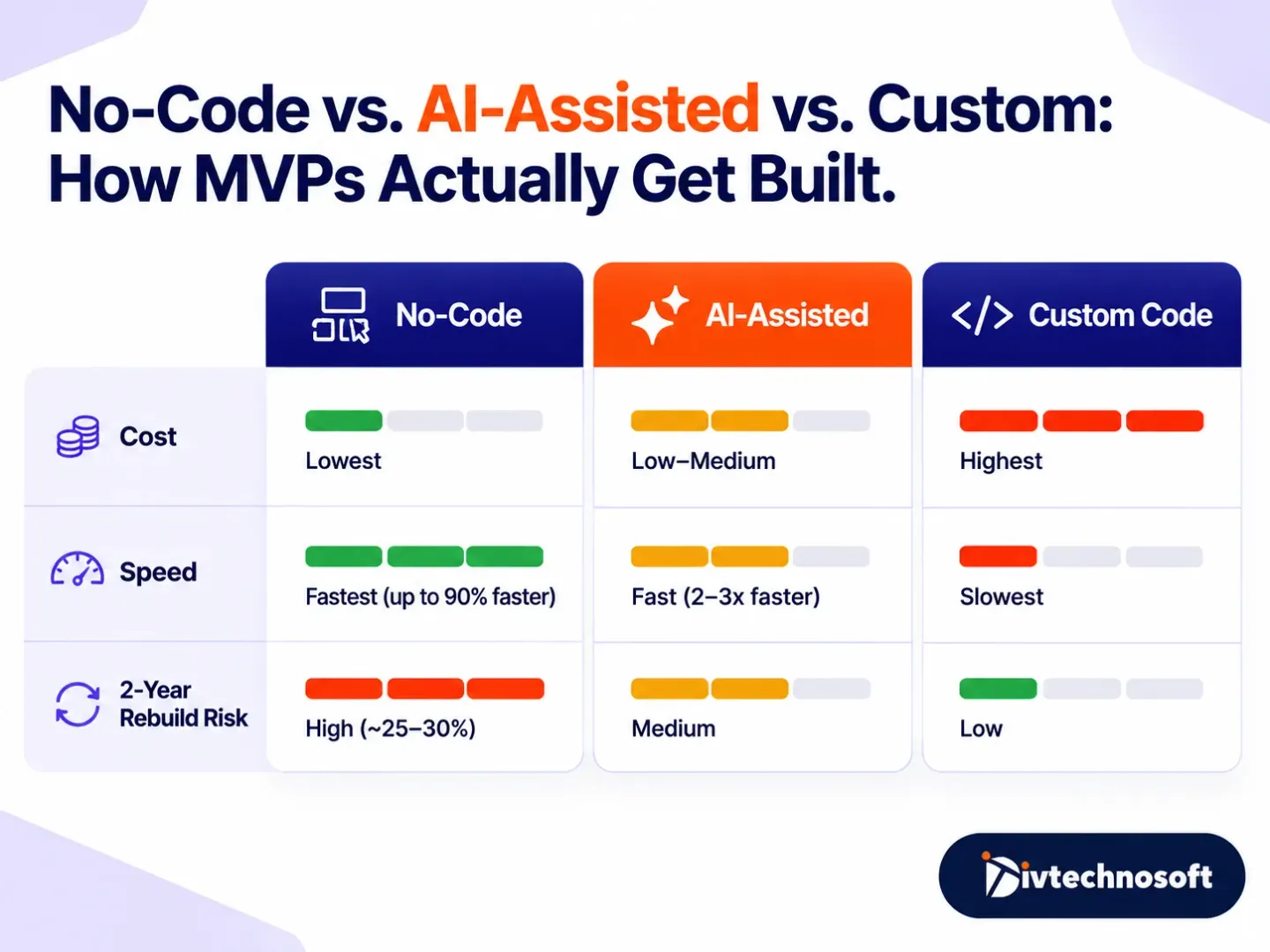
No-code can cut build time by up to 90% and cost by 50-70% versus fully custom code for simple apps
The tradeoff shows up later: 25-30% of no-code MVPs get rewritten in custom code within two years, once they hit performance ceilings or feature limits the platform can't clear
AI-assisted development
40% of new SaaS MVPs in 2026 are built primarily with AI-assisted coding; vibe coding, agentic coding, whatever your team calls it
In Y Combinator's Winter 2025 batch, about a quarter of startups had codebases that were 95% AI-generated
Founders report shipping 2-3x faster with AI-assisted tools; the gap widens when a non-technical founder can iterate on the prototype directly in tools like v0 or Lovable
Tool choice splits by company size: one 2026 developer survey found 75% of small startups running on Claude Code versus 56% of large enterprises on GitHub Copilot, which still wins on procurement and compliance grounds at scale
We go deeper on tool selection and workflow inhow to build an MVP with AI and launch it.
The risk data worth sitting with
40-48% of AI-generated code has tested positive for security vulnerabilities in independent audits
One controlled trial found experienced developers ran about 19% slower with early-2025 AI tools on complex, mature codebases
The speed gains are real, but they cluster in greenfield, low-complexity work; that describes most MVPs, and stops describing your product the moment it needs to scale
The hybrid default
What wins in 2026 isn't one method over another. It's the hybrid: no-code or AI-assisted tooling for the front end and the validation layer, custom engineering reserved for the backend and anything security or compliance-critical. That's what technical YC founders are already doing instead of picking a side.
Why MVPs fail
The reasons haven't shifted much even as the tools have:
43% of startup failures trace to poor product-market fit; the largest single category in CB Insights' review of 431 VC-backed shutdowns since 2023
Broader estimates put failures tied to no real market need or premature scaling at 35-90%; the wide spread mostly reflects how loosely different firms define "failure"
Startups that validate before building at full scale are far more likely to scale successfully than ones that build the complete product first and test later
65% of failed startups cite team issues (co-founder conflict, bad early hires, leadership gaps) as a primary contributing cause; MVP failure is often organizational before it's technical
Two-founder teams raise roughly 30% more capital than solo founders, all else equal, which matters when you're deciding who builds the MVP
Time to product-market fit after launch
Shipping the MVP isn't the finish line. Most MVP statistics posts stop at launch; this is the part that actually determines whether the build was worth it.
Time to PMF runs 6-24 months post-launch for most products
Consumer and simple SaaS sit at the short end; healthcare, fintech, and other regulated categories run 24-36 months, since compliance and procurement slow everything down
The average startup pivots 2-3 times before finding fit
Founders who pivot raise 2.5x more capital and post 3.6x better user growth than founders who never adjust the core model; investors read a pivot as responsiveness to data, not as failure
The benchmark most teams still use is Sean Ellis's 40% rule: the share of users who'd be "very disappointed" without the product. Under 25% means you're not ready to spend on scale yet
How MVP quality maps to funding
This is where MVP development and fundraising stop being separate conversations.
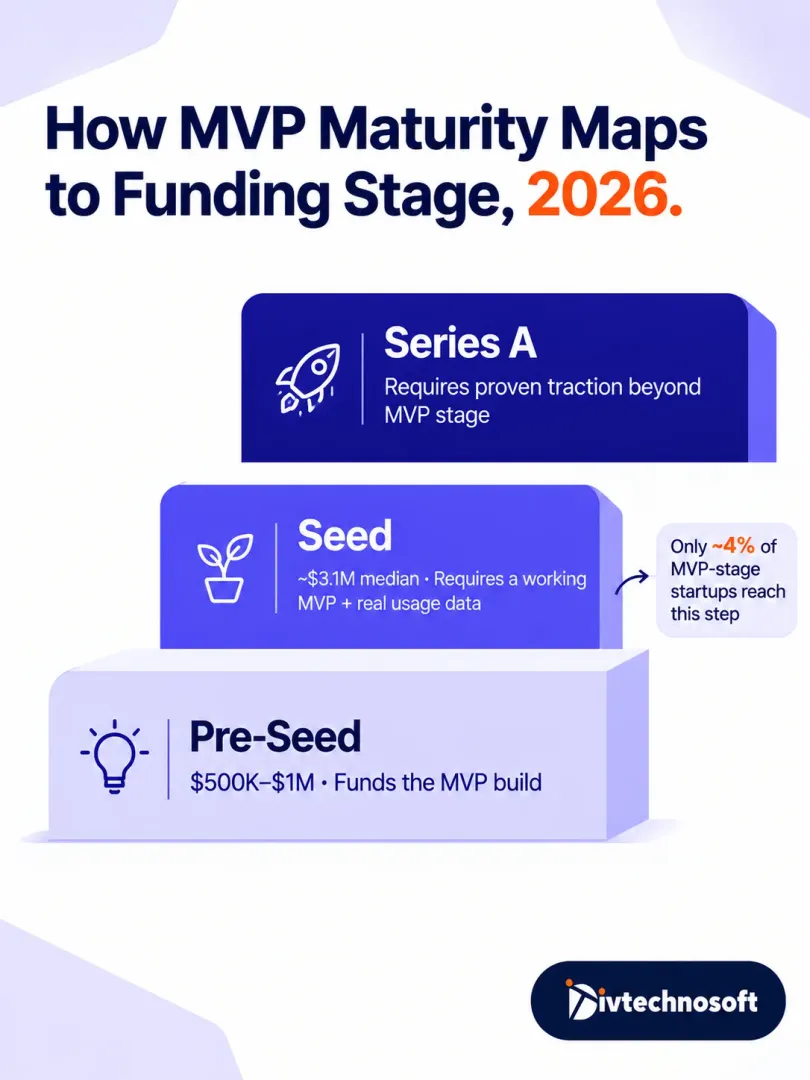
Pre-seed money, typically $500K-$1M in 2026, is earmarked specifically to build the MVP; it funds the first version, not the growth after it
By seed stage, investors want a working product with real user feedback, not a prototype, plus early revenue signals in the $300K-$500K ARR range for many categories
The median U.S. seed round hit roughly $3.1 million in 2026, even as seed deal volume dropped about 28% year over year; fewer startups get funded, but the ones that do clear a higher product bar for a bigger check
Only about 4% of startups that ship an MVP ever reach that round
Cheaper build tooling has raised the bar rather than lowered it. AI-assisted and no-code development mean investors now expect more traction for less capital raised, since the engineering work that used to require a funded team is available pre-revenue.
What this means if you build one now
Three things hold up once you look past the individual numbers.
Building got cheap faster than validating got easier. AI-assisted coding and no-code tools have made shipping something faster and less expensive than at any point before, but the 43% failure rate tied to poor product-market fit hasn't moved. Cheap tooling makes it easier to skip the discovery work the data says actually predicts success
Hybrid builds are beating ideological ones. Founders getting the best mix of speed and durability aren't choosing no-code over custom, or AI-assisted over hand-written. They use AI and no-code where speed and cheap validation matter, and reserve custom engineering for what needs to scale or stay secure
The MVP is a fundraising artifact now, not just a product one. Pre-seed funds the build directly, and seed investors want real usage data before they'll write a check. The bar for what counts as "minimum viable" has gone up even as the cost of clearing it has gone down
This is the layer we build in at Divtechnosoft: validated ideas turned into shipped MVPs, usually in six to eight weeks, using the hybrid AI-assisted approach this data points toward. If you're still scoping the idea itself, ourproduct strategy work starts there; once you're ready to build, our MVP development services page walks through how we structure discovery, build, and post-launch iteration.
FAQs
How much does MVP development cost in 2026?
Most custom MVPs run $15,000-$120,000, with typical spend at $40,000-$80,000. Simple, single-workflow products can come in under $55,000; AI-powered or compliance-heavy builds can exceed $150,000-$300,000.
How long does it take to build an MVP in 2026?
Simple MVPs ship in 6-8 weeks. Standard builds with accounts, payments, and integrations run 3-6 months. AI-assisted coding has cut typical build time by 30-60% versus pre-2024 timelines.
Is no-code enough for a real MVP, or do you need custom development?
No-code can validate an idea faster and cheaper, and is projected to power 70-75% of new applications by the end of 2026. But 25-30% of no-code MVPs get rebuilt in custom code within two years. A hybrid build (no-code or AI-assisted front end, custom backend) is the default recommendation.
Why do most MVPs fail after launch?
Poor product-market fit, cited in 43% of CB Insights-tracked VC-backed shutdowns. It's rarely a code problem. Most MVPs that fail were technically shipped fine; they just weren't validated against real demand first.
How does the MVP affect fundraising?
Pre-seed capital is generally earmarked to fund the MVP build itself. By seed, investors want a working product with usage data and early revenue signals, not a prototype. Only about 4% of startups that ship an MVP make it to a seed round.