Talent Management System Development Guide
A business guide to talent management system development: features, build vs buy, real costs, security, AI, and how to choose a partner.

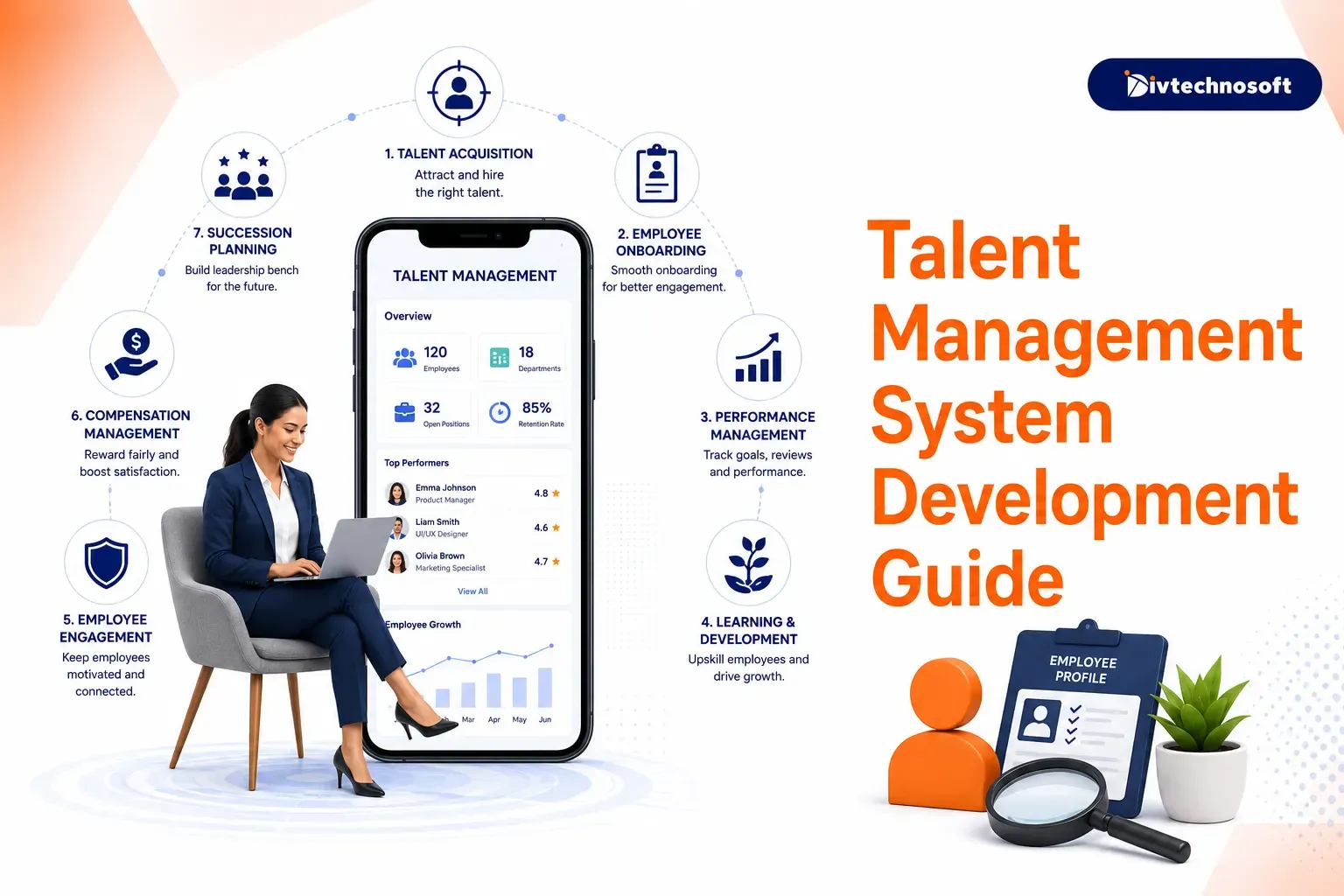
Talent management used to mean filling open seats. Now it's closer to the operating system for how a company lives out its mission through its people , and most companies are still running that operating system on duct tape.
Hiring lives in one tool. Reviews happen in a spreadsheet updated twice a year. Training gets tracked in a shared folder nobody opens. Each gap is small on its own, but they compound into double data entry, decisions made on gut feel, and good people leaving before anyone notices the pattern.
A Talent Management System (TMS) exists to fix exactly that , recruiting, performance, learning, and succession, on one shared record instead of five disconnected ones. Analysts valued the market at roughly $10.3 billion in 2024 and expect it to clear $30 billion by 2033.
This guide is for business leaders, not engineers: what a TMS actually does module by module, what separates a good implementation from a checkbox one, what it costs, build vs. buy, and how to choose a partner if you go custom.
What a TMS Actually Does
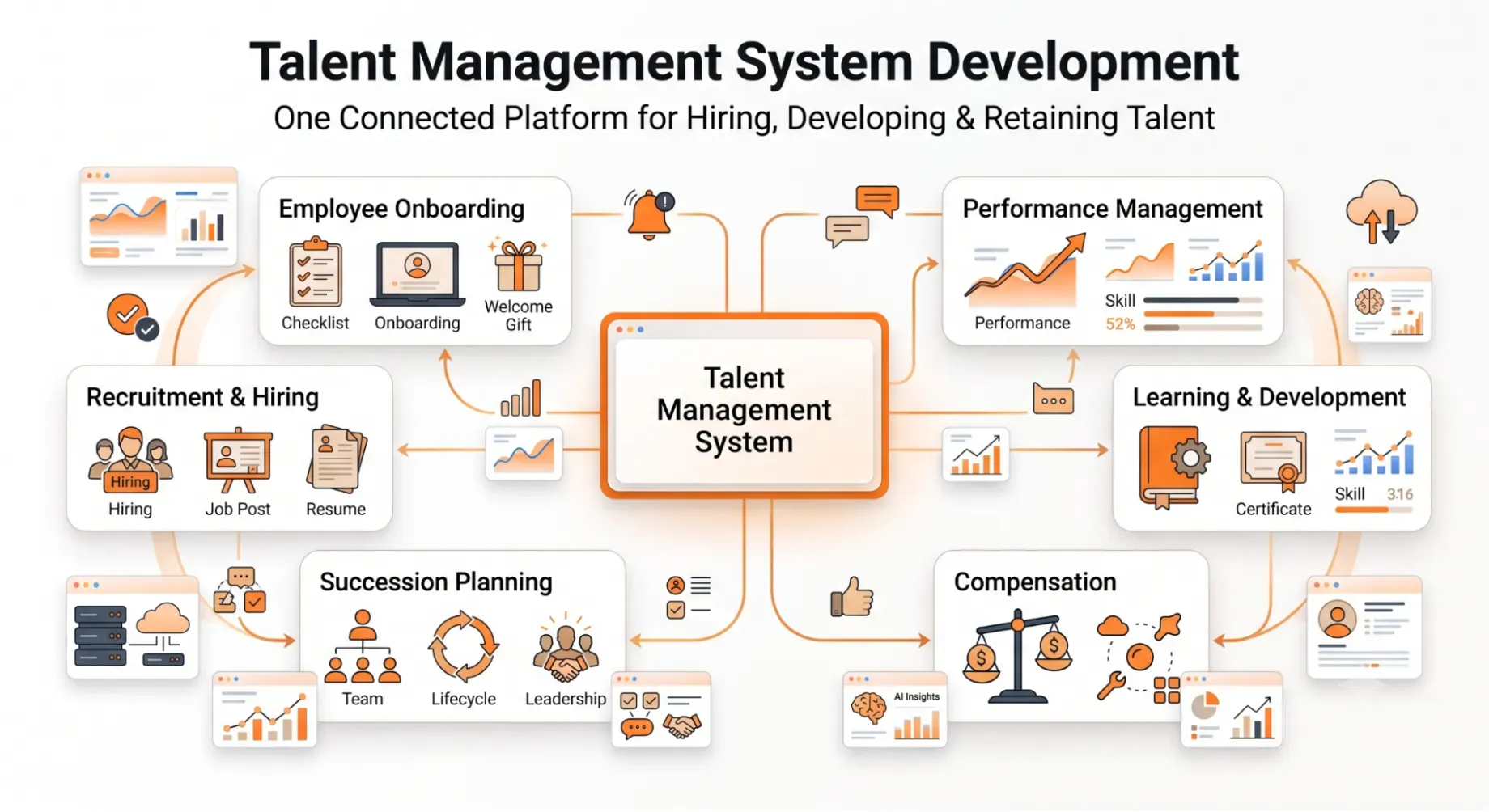
Strip away the marketing language and a TMS is software that follows one person through their entire time at your company , application, onboarding, every review, every training assignment, up to a promotion or exit. One record, not five.
The value isn't really the record-keeping, though , plenty of tools store data. What makes a TMS worth building or buying is that it turns scattered HR activity into something actionable: who's ready for a promotion, where skill gaps are forming, which team is quietly bleeding talent. A filing cabinet doesn't tell you any of that. A real system does.
The Core Modules and What "Good" Looks Like in Each
Most platforms are built around the same handful of modules. Where they differ is how well each one actually works.
Recruiting and onboarding: Applicant tracking and new-hire flows. The weak version tracks resumes in a pipeline; the good version carries candidate data straight into the employee record on day one, so onboarding isn't a re-entry exercise.
Performance and goals: Goal-setting, reviews, feedback , ideally continuous, not annual. The strong version ties individual goals to company objectives and treats feedback as a habit, not an event.
Learning and development: Course assignments and skill tracking. Done well, recommendations come out of actual gaps performance reviews already surfaced, instead of assigning the same generic course to everyone in a role.
Compensation management: Pay bands and bonus cycles tied to performance data, instead of reconciled by hand in a separate spreadsheet.
Succession planning: Who's ready for what's next, and a development path to get them there. The bar here is high: real readiness scoring runs on performance trajectory and skills built, not a manager's gut feeling entered once a year.
Analytics and reporting: Dashboards that answer what leadership actually asks , top performers, pay competitiveness, attrition risk , not a generic report builder that technically has the data somewhere in it.
Why the Connections Between Modules Matter More Than Any Single One
Here's what's easy to miss evaluating a TMS module by module: none of them are worth much in isolation. The value shows up in the handoffs.
Performance data should feed learning recommendations. Learning progress should feed succession readiness. Succession gaps should inform recruiting priorities before a role even opens. When that flows automatically, HR stops being a record-keeper and starts being a planning function. When it doesn't, you've bought five point solutions with a shared login screen , not a talent management system. It's the single best question to ask any vendor or dev partner: show me how data actually moves between modules, not just that both modules exist.
Signs Your Business Needs a TMS
Hiring, reviews, and training live in tools that don't talk to each other.
HR spends real hours on manual data entry and chasing forms.
You can't quickly answer "who are our top performers?"
Good people are leaving, and you find out why after they've gone.
You're growing fast enough that spreadsheets are actively working against you.
Two or more rings usually means the system will pay for itself.
Build, Buy, or Customize
Buy when your processes look like everyone else's and speed matters more than customization. Build custom when your workflows are genuinely different, or you're scaling hard enough that an off-the-shelf tool starts creaking, at that point, you're really talking about amulti-tenant, scalable platform of your own, not a one-off internal tool. Plenty of companies do both in sequence , buy first to get moving, build once they know exactly what the off-the-shelf tool can't give them.
What a Talent Management System Costs
Buying most tools price per employee per month , entry tools run $4–$12, full suites $15–$25 or more. For a 100-person company, a three-year total cost (license, setup, migration, training) often lands near $75,000, and setup fees alone can equal 50–100% of the first year's license.
Building custom costs more upfront but you own the result. A focused first phase often starts around $50,000; a full multi-module system can run into the low hundreds of thousands over a year or more.
Weigh either number against the problem it solves: replacing one employee typically costs half to two times their annual salary, so a system that even modestly improves retention can cover its own cost quickly. All figures here are estimates that vary by size and region , always ask for the full cost of ownership, not just the sticker price.
How a Custom TMS Gets Built
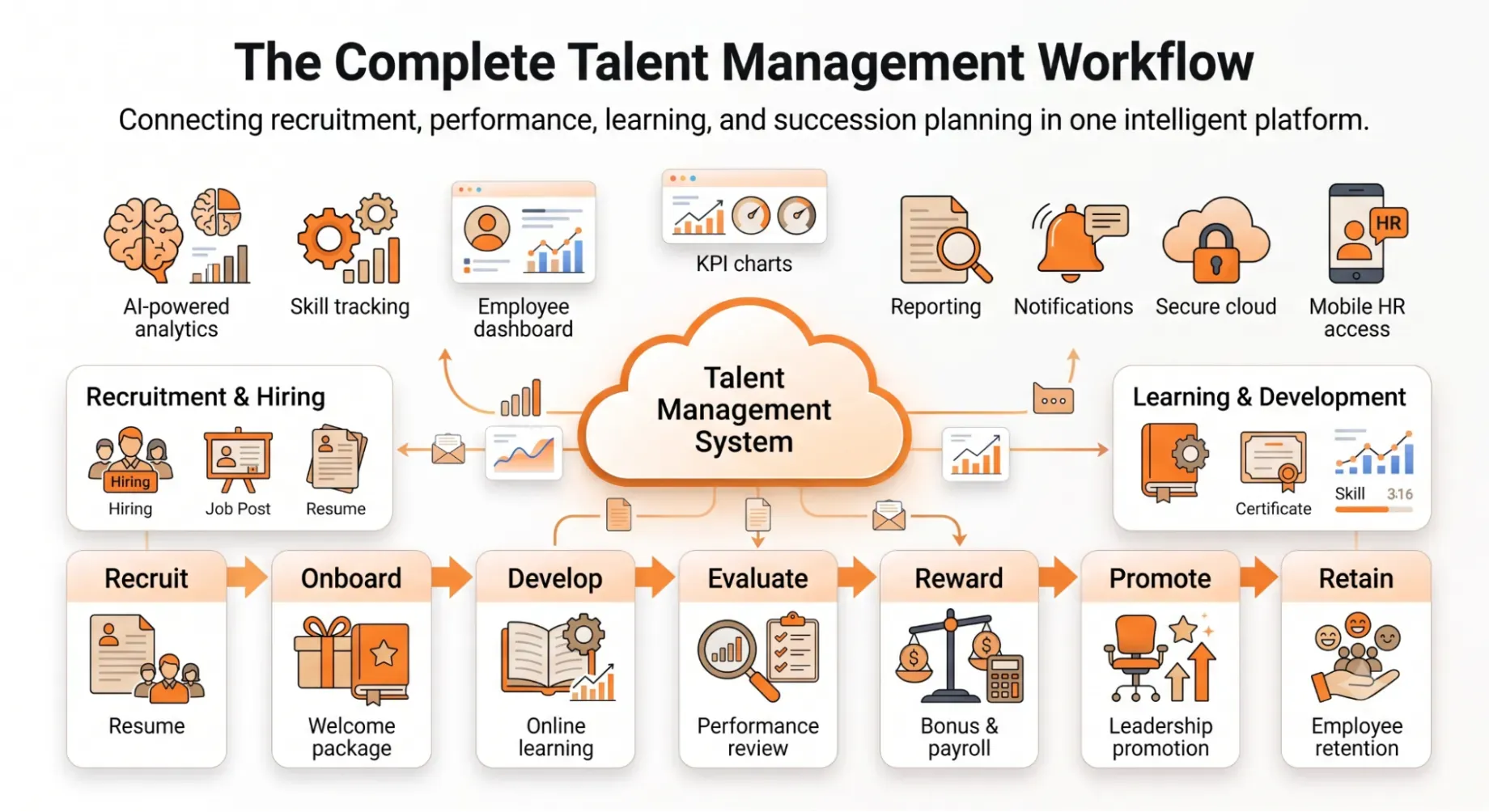
Trying to build all of this at once is how these projects stall. The smarter path is phased: map how a person actually moves through your company , hired, onboarded, reviewed, trained, promoted , before writing any code. Getting that mapping right is genuinely roadmap and positioning work and rushing it is one of the more expensive mistakes teams make.
A common phased path: core records first, then recruiting and onboarding, then performance, then growth (learning, succession, analytics). Ship phase one, get real users on it, and let their feedback shape what comes next. If you want to validate core requirements before committing to the full build, MVP development services are a reasonable place to start small.
Keeping HR Data Safe
A TMS holds some of the most sensitive data a company has. At minimum, insist on role-based access, privacy compliance (GDPR and local labor law), audit logs, and encryption both at rest and in transit. This isn't just a compliance checkbox , employees engage more honestly with a system they trust is actually protected.
AI in Talent Management
AI is showing up fastest in the modules that used to be hardest to get right: forecasting who's likely to leave, spotting skill gaps early, matching people to roles they haven't applied for. Gartner found 87% of companies are already facing skill gaps or expect to soon , a system that surfaces those automatically turns HR from reactive to genuinely strategic. Feedback frequency matters just as much: SHRM research links continuous reviews to a 29% rise in engagement. You don't need a full AI suite on day one , a model that flags flight risk or suggests relevant training is a solid first step.
Driving Adoption Across Teams
None of this matters if people don't use it. A clunky tool gets ignored within weeks, and adoption dropping means your data goes stale right along with it. This is largely UI/UX design territory , a clean, mobile-friendly interface, fewer clicks for common tasks, short in-app guidance for new users. Train managers first, since they drive most day-to-day usage, then keep fixing friction as feedback comes in. Adoption is what actually turns a system into insight; everything before that is just infrastructure.
How to Choose a Development Partner
Screen for real HR domain experience, a portfolio with live examples and references (not just case study slides), security built in from the start rather than bolted on before launch, and honest, regular communication. Also ask about post-launch support , a lot of these systems quietly succeed or fail in their first year after launch, not during the build. Don't choose on price alone; a cheap build that fails costs more than a solid one would have. Reviewing the top MVP development companies is a useful way to see how different teams approach scoping a first phase.
Frequently Asked Questions
How much does it cost to build a talent management system?
A custom build typically starts around $50,000 for a first phase and can reach the low hundreds of thousands for a full system. Buying a SaaS tool runs roughly $4–$25 per employee per month.
Should I build or buy a TMS?
Buy if your processes are fairly standard and speed matters. Build if your workflows are genuinely unique or you're scaling hard. Many companies buy first, then build later.
What's the difference between an HRIS and a TMS?
An HRIS handles the administrative side , payroll, benefits, compliance records. A TMS answers a different question: how do you find, develop, and keep the best people? The two usually work together, with the HRIS feeding basic employee data into the TMS.
How long does it take to build one?
A phased custom build often takes a year or more, with the first phase , core employee records , usually a few months. Buying and implementing an existing tool is faster, typically weeks to a few months.
Do small teams need a TMS?
Not always. It tends to pay off once hiring, reviews, and training get genuinely hard to track by hand.
Conclusion
A modern talent management system turns scattered HR work into workflows people can actually rely on day to day. The goal underneath it is simple: put the right people in the right roles, and give them a real path to grow.
Decide whether to buy or build, budget for the full cost rather than the sticker price, take data security seriously from the start, and build around the modules your team will genuinely use , not the ones that look good on a features page.
If you're ready to build a scalable HR platform, the team at Divtechnosoft can help turn that plan into a market-ready product.