How Much Does it Cost to Build an MVP? A Complete 2026 Breakdown
Learn how much it costs to build an MVP, including key factors, pricing breakdowns, and tips to reduce development expenses.

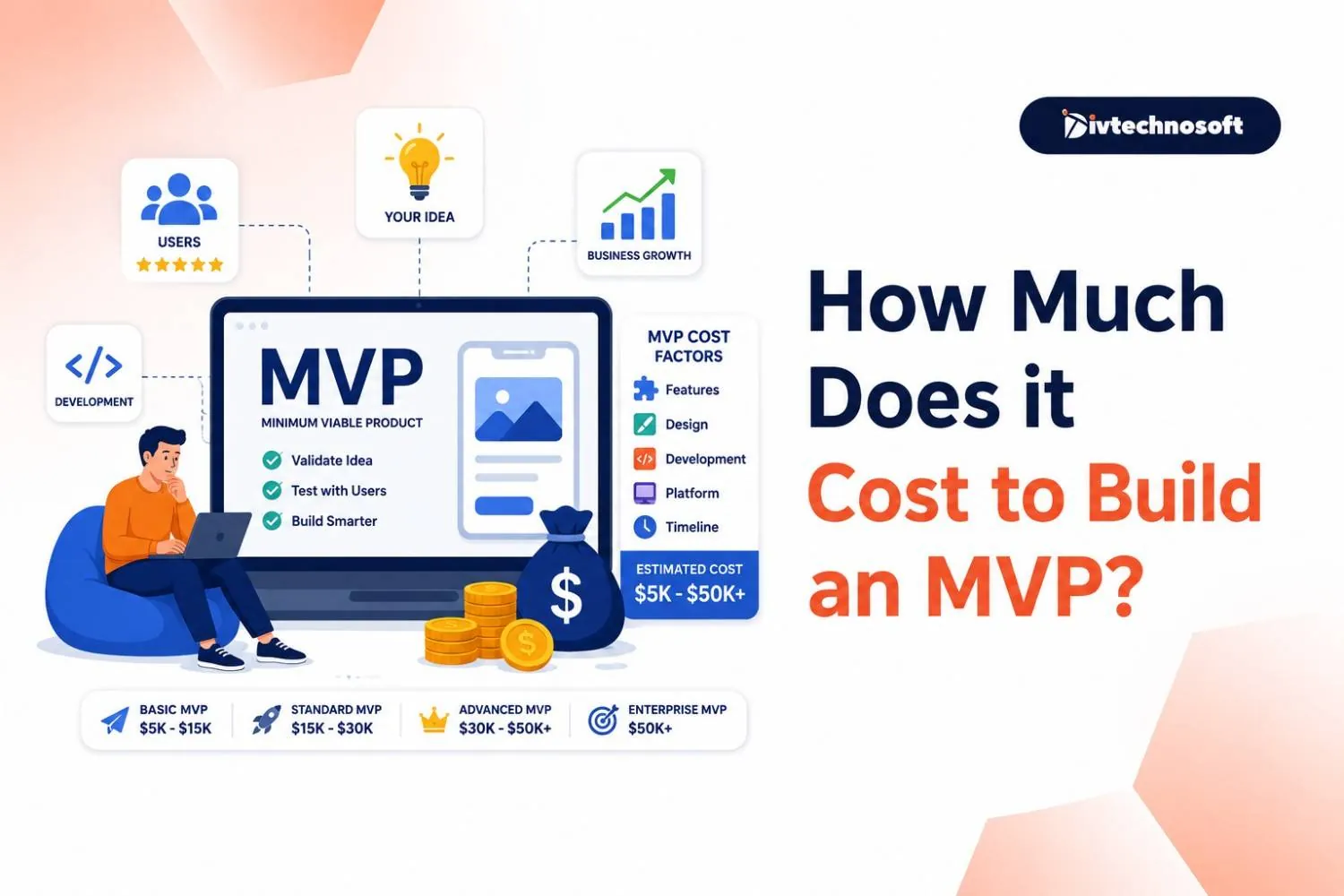
Ask five agencies "how much does an MVP cost?" and you'll get five different numbers, all of them technically true. That's not agencies being cagey , it's because MVP cost isn't really one number. It's the output of a handful of decisions: how complex the thing is, who's building it, where they're sitting, and which platform you're shipping to. Change any one of those and the price moves, sometimes by a factor of ten.
Zoom out far enough and the published range across the industry lands somewhere between $10,000 and $150,000+, with some quotes for enterprise-grade builds pushing past $400,000. That's a technically correct answer and a practically useless one. So let's actually break it down.
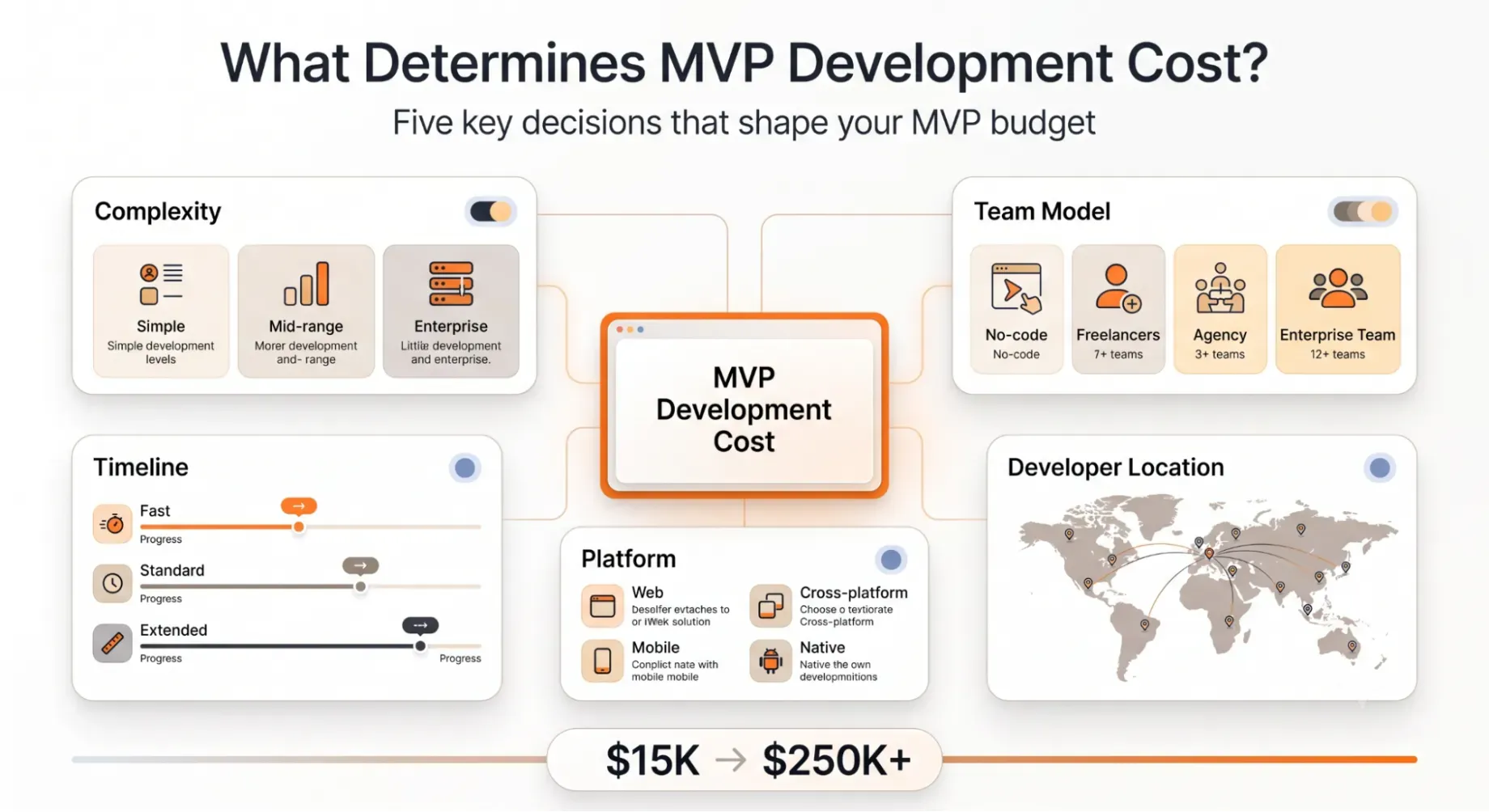
Why MVP Cost Is a Range, Not a Number
A landing page testing demand for a new service and a HIPAA-compliant healthcare app both get called "MVPs." They have almost nothing else in common, cost-wise. The thing is, the biggest lever on your budget usually gets decided before anyone touches a keyboard , it'sproduct strategy work, plain and simple: deciding what actually needs to exist to test your hypothesis, and what's just a nice-to-have you've talked yourself into. Get that call right and you can land at the low end of almost any tier below. Get it wrong and no development team, however cheap, saves the budget.
MVP Cost by Complexity Tier
This is the variable everyone starts with, and for good reason , it's the biggest single driver.
Tier | Cost Range | Typical Timeline | Best For |
|---|---|---|---|
Simple | $15,000 – $40,000 | 6–10 weeks | One core feature, single platform, testing basic demand |
Mid-range | $40,000 – $100,000 | 10–16 weeks | User accounts, payments, analytics, first paying customers |
Complex | $100,000 – $250,000+ | 16–24 weeks | AI components, real-time data, regulated industries |
These bands aren't a number we picked out of the air , they track with what firms like Designli, SoftTeco, and TeaCode publish for comparable tiers, with the floor sitting around $10,000–$15,000 for the leanest builds and the ceiling climbing well past $250,000 once you're deep into enterprise-scale integrations.
MVP Cost by Team Model
Here's the variable most cost breakdowns skip, and it moves the number just as much as complexity does: who's actually building it.
Team Model | Typical Cost | Tradeoff |
|---|---|---|
No-code / solo build | $2,000 – $15,000 | Fastest and cheapest, but limited to what no-code tools support |
Freelance developer(s) | $15,000 – $50,000 | Cheaper than an agency, but quality and reliability vary a lot |
Boutique / offshore agency | $25,000 – $120,000 | A full team and a real process, more predictable delivery |
Full-service enterprise agency | $100,000 – $400,000+ | Priciest option, but built for scale, compliance, and staying power |
If you don't have engineering in-house, this is usually the point where bringing in a dedicatedMVP development partner pays for itself , not because the hourly math necessarily favors it, but because the gap between team models is often smaller than the cost of rebuilding after a rushed first attempt falls apart.
MVP Cost by Developer Location
Where your team sits is the other big lever, and it's not subtle:
Region | Typical Hourly Rate |
|---|---|
United States | $95 – $250 |
UK / Western Europe | $50 – $199 |
Eastern Europe | $35 – $90 |
Latin America | $25 – $95 |
India / South Asia | $15 – $65 |
Here's the part most guides leave out, though: the quoted hourly rate is almost never the real cost. Once you factor in management overhead, onboarding, and the extra time communication takes across a team, the effective cost tends to land at something like 1.4x to 1.8x the headline rate , in every region. It's why two quotes at the same hourly rate can still turn into very different invoices by the end of the project.
MVP Cost by Platform
Platform choice touches both engineering cost and design cost, and it's worth deciding early rather than mid-build. A responsive web app is, almost without exception, the cheapest place to start. If mobile is genuinely non-negotiable, cross-platform frameworks like Flutter or React Native are commonly estimated to run around 30% cheaper than building fully separate native iOS and Android apps, since most of the codebase is shared between them. Going fully native on both platforms costs meaningfully more , you're largely duplicating design and engineering work across two codebases. And wherever you land on the platform, don't shortchangeUI/UX design to save a few dollars. It's usually a smaller slice of the budget than engineering, but it's the part users actually judge the product on in the first ten seconds.
Hidden and Post-Launch Costs
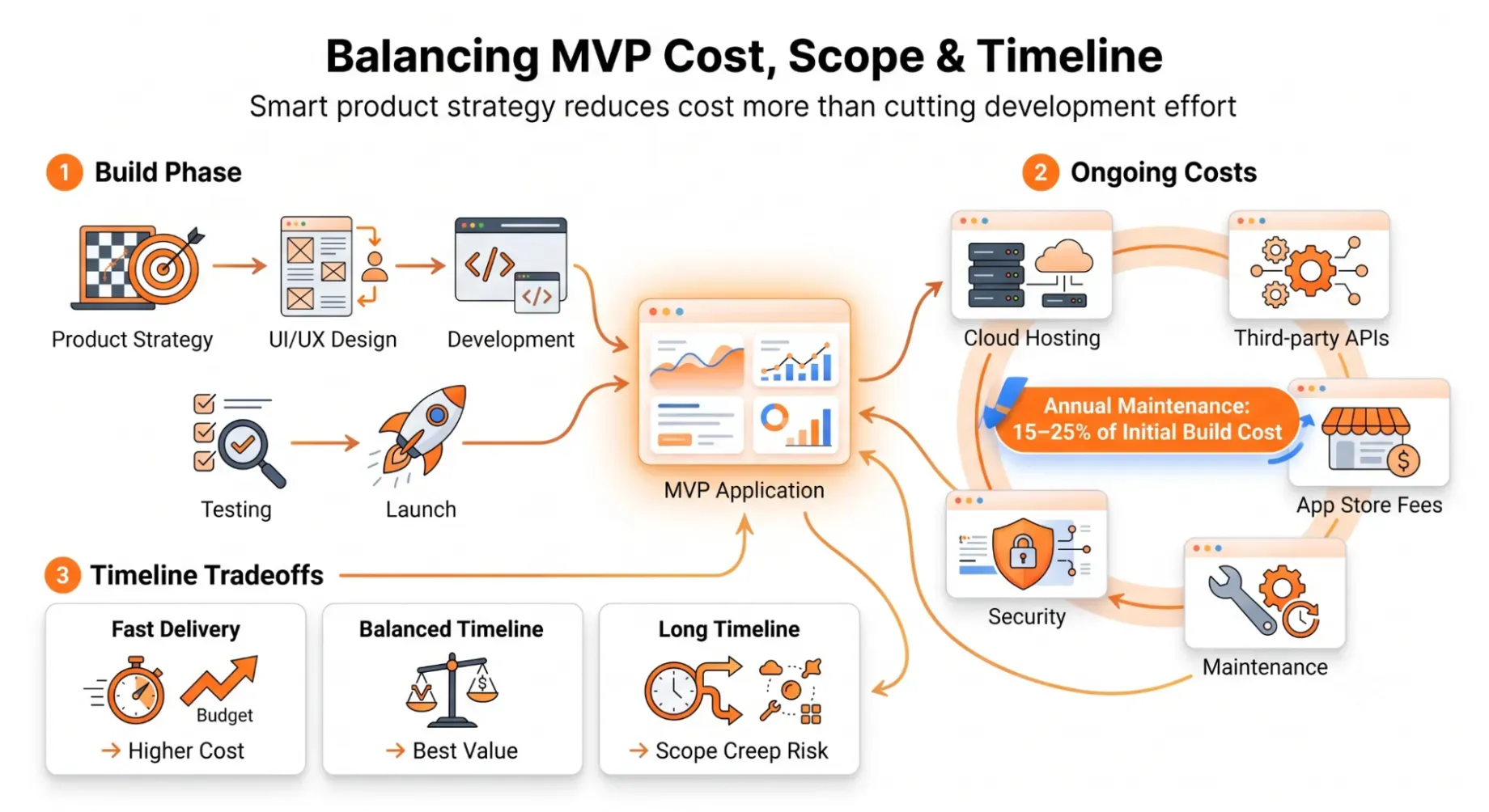
The build is only half the financial story, and it's the half everyone remembers to budget for. Here's what usually gets forgotten:
Cloud hosting: Typically $100–$500/month for AWS or Google Cloud at MVP scale.
Third-party APIs: Usage-based, so costs for tools like OpenAI or Stripe scale with your traffic, not your team size.
App store fees: Annual developer fees, plus Apple and Google both take a cut of in-app purchases.
Ongoing maintenance: This is the one that actually surprises people. A benchmark that shows up consistently across independent cost studies puts annual maintenance at roughly 15–25% of the original build cost, and its cumulative maintenance spend can pass the original build cost within a few years on a product that's actually being used and iterated on.
We'd argue this is where most first-time founders under budget. The build is a one-time line item;ongoing maintenance and support is recurring, and it deserves its own place in the plan from day one , not a surprise 18 months after launch.
Cost vs. Timeline: The Tradeoff Nobody Prices In
Cost and timeline pull against each other, and most budgeting conversations only think about one direction of that.
Squeeze the timeline and cost goes up , parallel workstreams, overtime, pulling in extra senior engineers to hit a deadline all carry a premium. Rushing doesn't just risk quality; it typically costs more per feature shipped, not less.
Stretch the timeline, though, and you don't automatically save money either. A longer build means more months paying a team (or burning your own runway) before anything ships, and scope has more time to quietly grow. In our experience, the cheapest path is rarely the fastest or the slowest , it's a tightly scoped feature set matched to a timeline with no dead time on either end.
The real lesson: a realistic timeline isn't just a scheduling detail. It's a cost-control tool in its own right.
How to Reduce Your MVP Cost
You don't need a bigger budget to ship something credible , you need tighter scope. Build only what tests your core hypothesis, and hold everything else for a validated v2. That's a product strategy call more than a technical one; the cheapest MVP worth building is the one with the fewest features that still proves the point. Past that, lean on existing managed services and no-code tools wherever they can stand in for custom-built infrastructure , authentication, payments, and hosting almost never need to be built from scratch this early.
FAQ
How much does a no-code MVP cost?
Usually $2,000–$15,000, depending on complexity. Significantly cheaper than a custom build, but you're limited to what the no-code platform natively supports.
Is $15,000 enough to build an MVP?
It can be, for a genuinely simple, single-platform product with one core feature. Below that, you're leaning heavily on no-code tools or a very narrow scope.
Why do MVP cost quotes vary so much between agencies?
Mostly team model and location. An enterprise agency in the US and a boutique offshore team can quote 5–10x apart for a nearly identical spec, and the hourly rate on the quote rarely reflects the fully loaded cost once overhead is added in.
How much should I budget for MVP maintenance after launch?
Roughly 15–25% of your initial build cost per year is the benchmark that shows up again and again in industry cost studies. Worth budgeting from day one instead of finding out the hard way.
The Bottom Line
There's no magic low number here , the founders who budget well are the ones who understand which variables are actually moving their estimate and make deliberate tradeoffs across them. Complexity, team model, location, platform, and timeline all interact with each other, and the right budget for your MVP comes from picking a defensible point across all five, not from anchoring on one industry-wide range and hoping for the best.
Divtechnosoft helps startups and enterprise teams build scalable MVPs aligned with their goals and budget , balancing cost, performance, and speed from planning through launch and beyond.