How to Test and Scale Your MVP: The Complete Guide
Discover essential strategies to test MVP before going live. Learn how to validate usability, fix bugs, and ensure a smooth launch for your product.

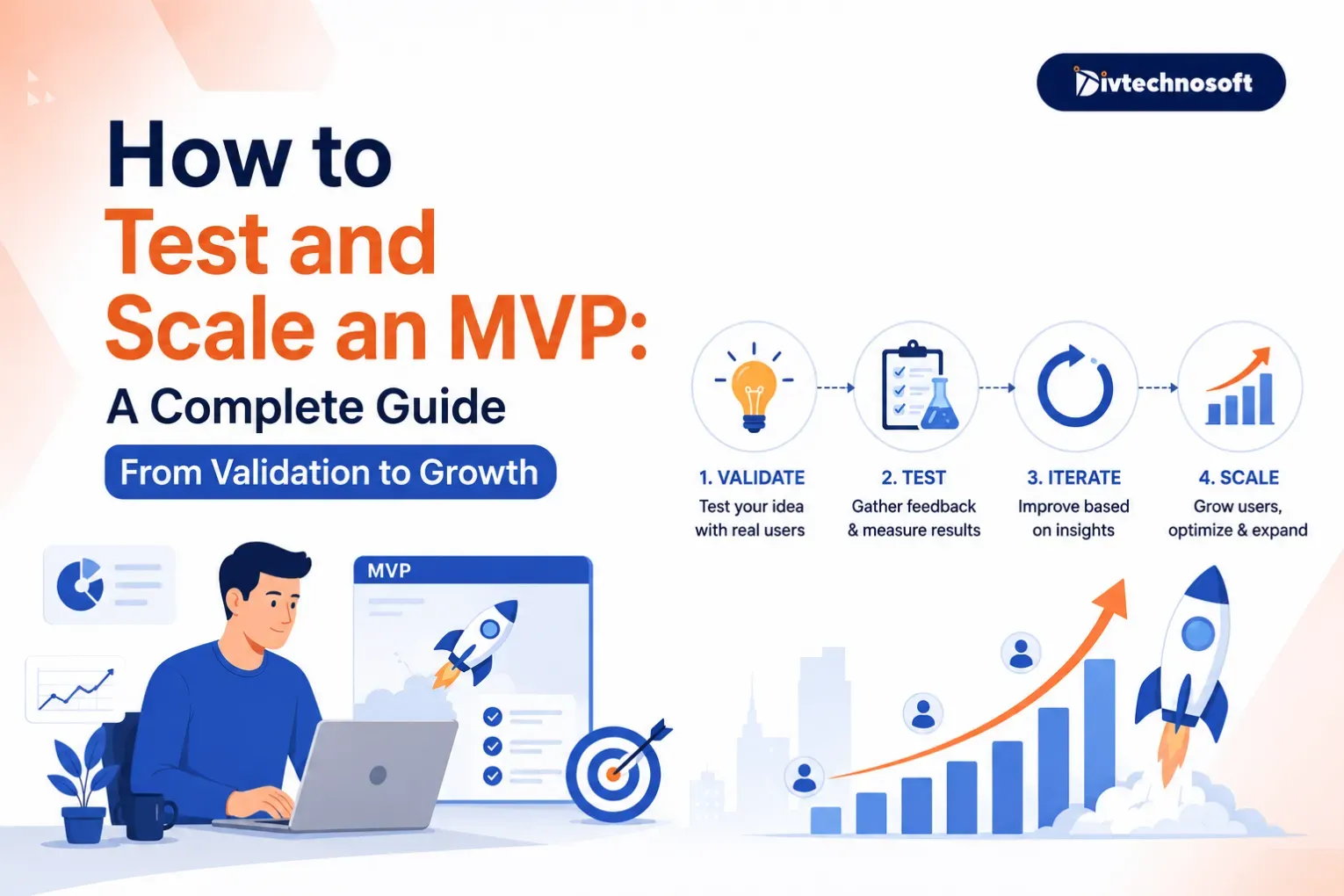
"Minimum" in Minimum Viable Product isn't about writing less code , it's about testing a hypothesis as cheaply as possible before committing real money to it. That distinction matters: CB Insights' analysis of startup post-mortems found that roughly 42% of failures trace back to building something the market didn't need, and "ran out of cash" , often cited as the top cause of failure , is frequently a downstream symptom of that same root cause, not an independent one.
This guide covers the full lifecycle: validate before you build, test before you launch, architect to scale, and keep learning after launch , for both startup and enterprise teams.
Why MVPs Actually Fail
Failures cluster in three places. Pre-build, teams skip validation and let scope creep , data from one large-sample startup analysis found MVPs launched with 10+ features failed at roughly 83%, versus about 32% for teams that launched with three to five. Build-phase, the product ships untested and usability, performance, or security problems surface live, in front of customers. Post-launch, a "success disaster" hits , a traffic spike or big client exposes architecture that was never meant to scale. Treating MVP work as validate to test to scale, rather than a single pre-launch checklist, is what separates products that survive contact with the market from ones that don't.
Phase 1: Validate Before You Build
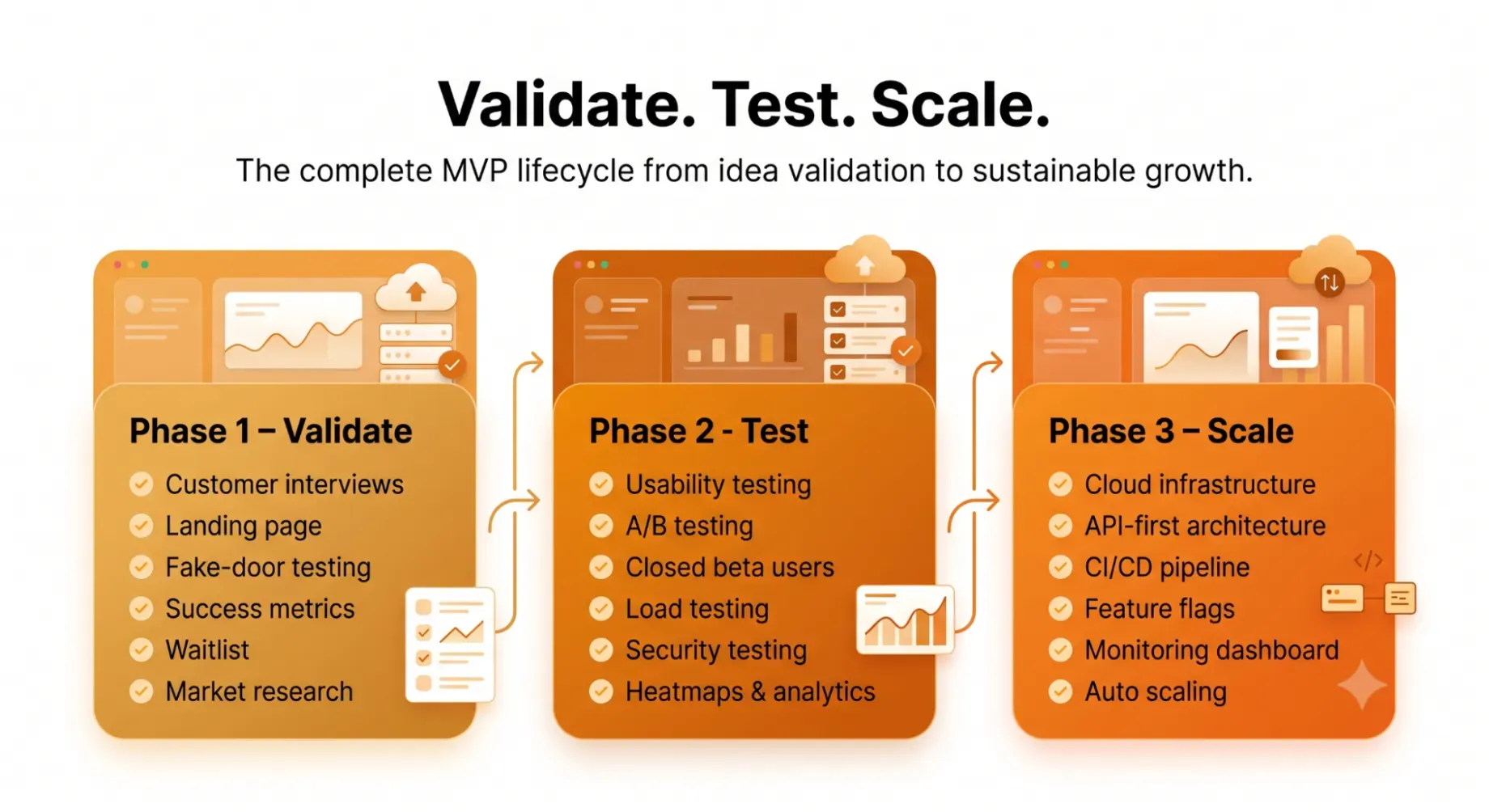
Define success metrics first. Decide what "working" looks like , a landing page conversion rate, a task-completion rate, a stickiness ratio , before you have users. Without this, teams default to vanity metrics like signups that don't prove anything.
Run 5 to 10 real customer interviews. Ask about behavior, not opinions: "when did you last try to solve this problem, and what did you do?" If nobody's already spent time or money on it, you likely have a nice-to-have.
Use fake-door tests. Put up a button or landing page for a feature that doesn't exist yet; when clicked, show "we're building this , join the waitlist." Click-through is a far more honest demand signal than a survey answer.
Phase 2: The Pre-Launch Testing Checklist
Usability testing: Give a user a real task ("create your first invoice") and watch, unassisted. What's obvious to your team is often a roadblock to a first-time user; a deliberateUI/UX design process catches most of this before it ever reaches testing.
A/B test your value proposition: The product can be right while the messaging is wrong. Split traffic across two framings and let conversion data pick the winner.
Dogfood internally: Your team should use the MVP daily before any customer does. If it feels clunky to them, it will to customers too.
Run a closed beta: 20 to 50 hand-picked early adopters who know they're testing a beta, in exchange for early access or founding-member perks.
Load-test before launch, not after: This is where MVPs quietly die from their own success. Google's mobile performance research found bounce probability rises roughly 32% as load time goes from one to three seconds, and each added second of delay can cost several points of conversion. Find your breaking point before your users do.
Security and compliance testing: Not a "v2" feature, especially with emails, passwords, or payments. Run basic penetration testing and confirm GDPR/CCPA/SOC 2 compliance as relevant. One breach at MVP stage can permanently damage trust.
Heatmaps and session recordings on a soft launch: A cheap way to catch users clicking non-interactive elements or scrolling past your CTA, before the real marketing push.
Phase 3: Architect an MVP That Survives Growth
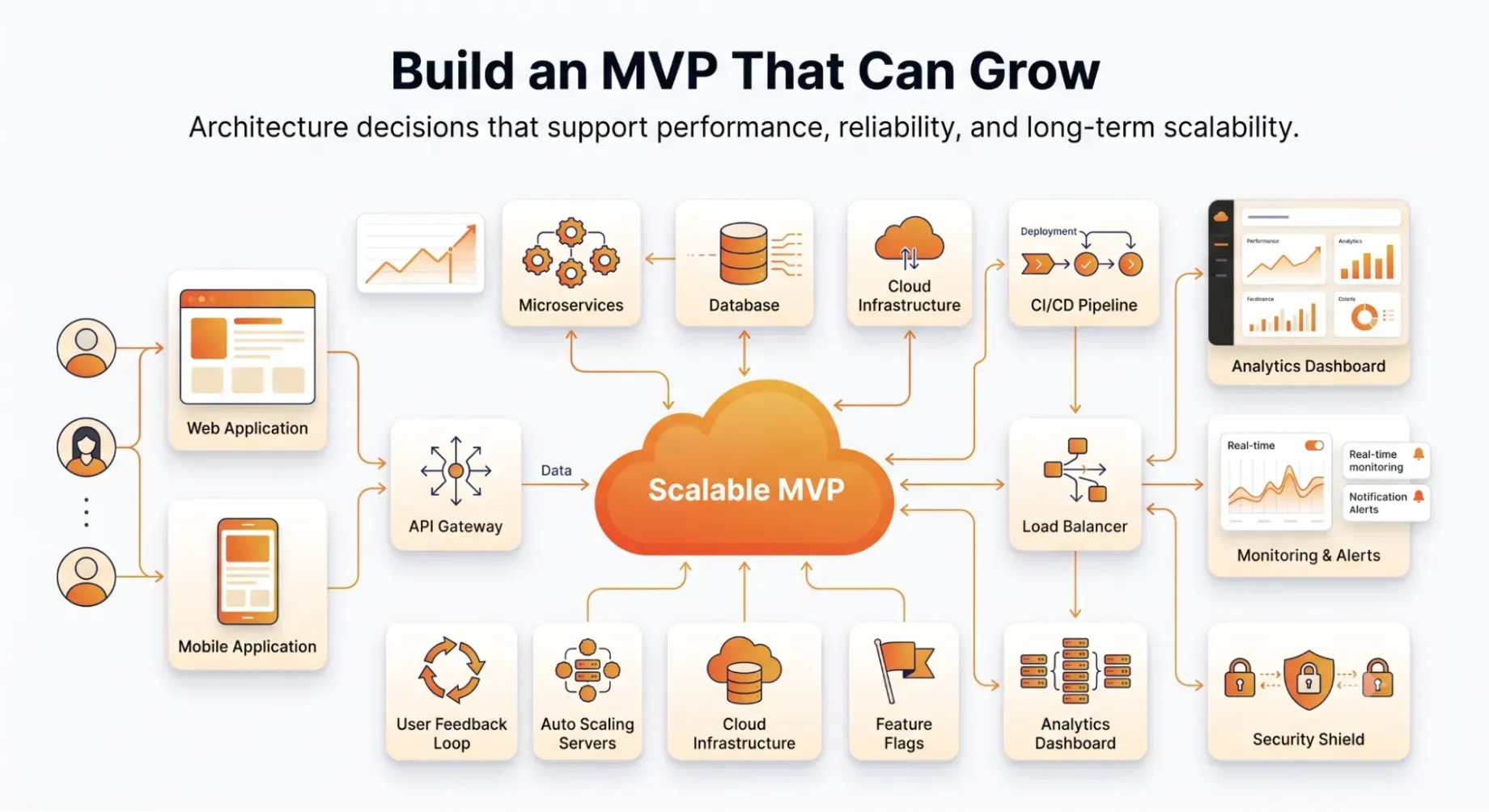
Testing proves the MVP works today, not that it'll hold at 10x users. This is often where teams bring in a dedicatedMVP development partner, since these are decisions that are expensive to unwind later. Build API-first, even with one client, so a mobile app or partner integration doesn't force a rewrite later. Choose a database structure that can absorb new fields and access patterns without a blocking migration. Ship new work behind feature flags instead of big-bang releases so you can roll back instantly. Put basic monitoring and CI/CD in place before you need them , the moment you need them is usually the moment something's already gone wrong. Run a light 30/60/90-day roadmap: stabilize what launch testing surfaced, prioritize validated feature requests, then start architecture for the next scale milestone.
Mobile-Specific Testing
Mobile MVPs need their own checklist items: test across a range of devices and OS versions, not one flagship phone. Build app store review time into your launch date , Apple's review especially can run longer than teams plan for. Mobile users are less patient with slow loads than desktop users , roughly half abandon a page taking longer than three seconds, and mobile pages tend to load slower on average. Test offline and poor-connectivity states deliberately; an MVP that only works on strong wifi will fail its first real test on a subway.
Startup vs. Enterprise: What Changes
Startups optimize for speed and cost , informal interviews, a fake door, a small external beta, fast toward a validated learning. Enterprise teams face different constraints: internal stakeholders function as your first beta group and buy-in matters as much as user feedback; compliance and security baselines usually can't be deferred to "v2"; integration testing against legacy systems is a core checklist item, not an edge case; and architecture (Phase 3) carries more weight, since rebuilding an enterprise MVP meets far more organizational resistance than a startup pivot does.
Post-Launch: The First 90 Days
Testing doesn't end at launch , it changes shape and this is usually whereongoing product maintenance and support takes over from the original build team. Build the feedback loop before launch: if a user hits a snag with no way to report it, most won't email support , they'll just leave. Watch for patterns, not individual opinions , two or three enthusiastic beta testers aren't a market. And expect product-market fit to take time , broader startup-timeline data puts it commonly beyond a year, with a meaningful share of companies taking over two.
Common Mistakes to Avoid
Testing only with friends or the internal team: They'll subconsciously forgive bugs. Strangers give the real signal.
Deferring performance testing until after a traffic spike: The conversion cost of slow load times is measurable, not hypothetical.
Treating a tiny beta sample as final validation: Three happy testers aren't statistically meaningful.
Launching with no feedback mechanism: Users who hit a wall with nowhere to report it just leave, quietly.
Building an MVP That's Actually Ready
The strongest MVPs come from teams that validate demand before building, run a genuine testing checklist rather than a token pass, architect deliberately for the growth they're hoping for, and treat the first 90 days as part of the build , not the finish line.
At Divtechnosoft, we help startups and enterprise teams build, test, and scale digital products across this entire lifecycle, from early validation through post-launch scaling. Whether you need a testing framework, a security review, or a backend built to hold up under real traffic, we're a strategic partner from prototype to scale.
FAQ
How long should MVP testing take before launch?
Most teams run one to two weeks of validation, then two to four weeks of dogfooding and closed beta before a soft launch. Enterprise MVPs typically run longer due to stakeholder and compliance review.
How many beta testers does an MVP need?
Roughly 20 to 50 engaged users who match your target customer is usually enough to surface real usability and reliability issues.
Do enterprise MVPs need different testing than startup MVPs?
Same core categories, plus integration testing against existing systems, heavier compliance review, and internal stakeholder alignment as an earlier step.